

May 7, 2026

16 mins
Jewelry Wholesale Management Software: From Manual Orders to Digital B2B
Discover how jewelry wholesale management software replaces manual spreadsheets with digital B2B tools for better inventory, pricing, and retailer fulfillment.
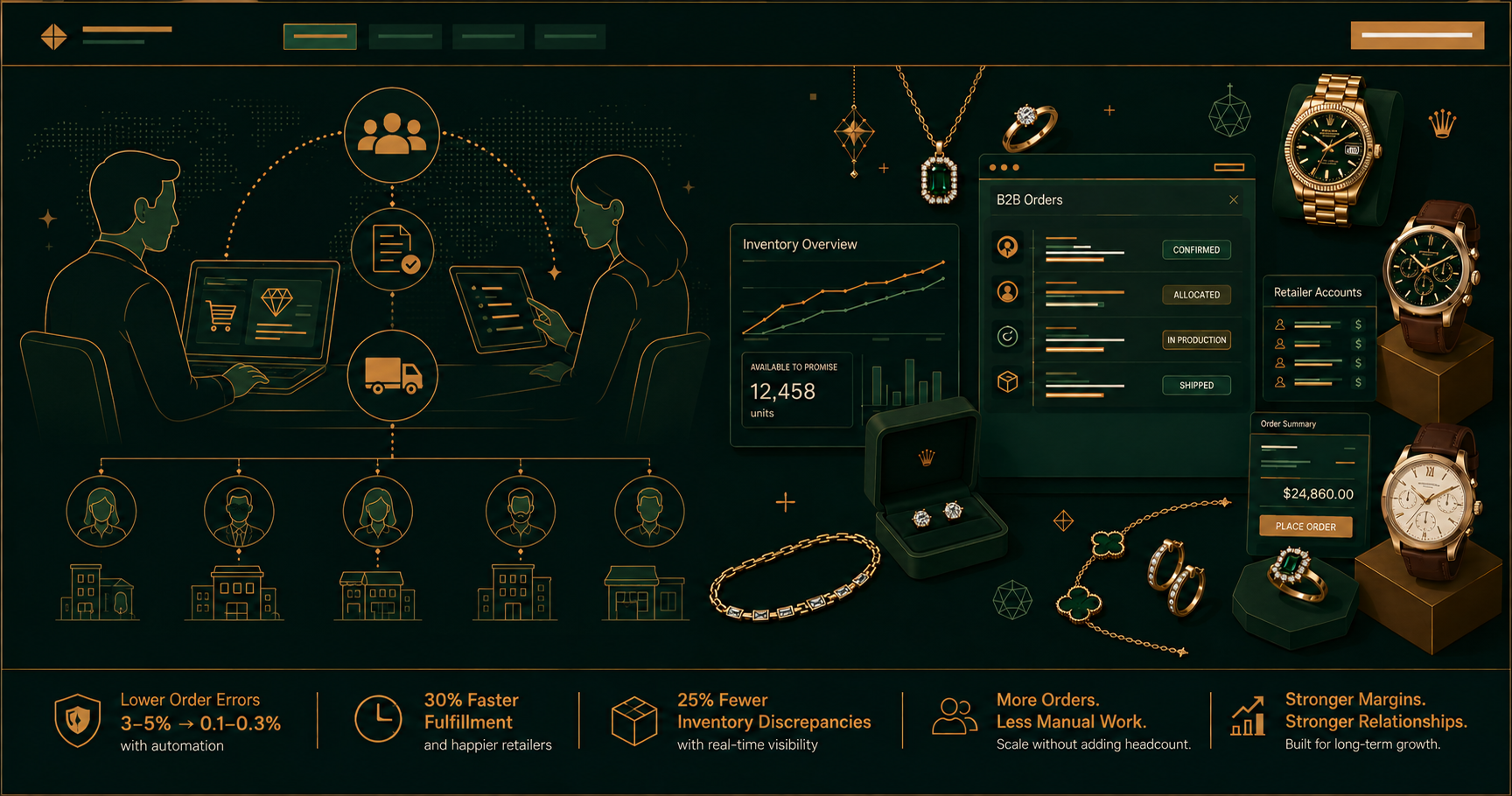
Most jewelry wholesale systems are just generic ERPs or retail tools struggling to handle B2B complexity. Luxare is different. It’s purpose-built to bridge the operational gaps those systems leave behind, managing serialized inventory and retailer accounts exactly the way a professional supplier actually runs.
Get Started with Luxare >>
Jewelry wholesale management software provides a single system for B2B orders, live inventory, and fulfillment tracking, eliminating the spreadsheets and manual re-entry that cause errors. If you manage accounts via phone, PDFs, and disconnected records, you aren’t running an operation, you’re managing a coordination problem that worsens with growth. This guide explains how jewelry software closes operational gaps, what features to prioritize, and why businesses often see results within the first quarter.
QUICK ANSWER BOX
Jewelry wholesale management software is a purpose-built platform that centralizes B2B order processing, real-time inventory tracking, retailer-specific pricing, and fulfillment workflows for jewelry manufacturers and wholesalers. It eliminates manual entry, reduces order errors, and gives retailers a self-service ordering experience while giving wholesale teams full operational visibility across every account.
Why Manual Wholesale Operations Are a Structural Problem, Not Just an Inconvenience
The global jewelry market reached about $365.9 billion in 2024 and is projected to grow to $580.7 billion by 2033 at a 5% CAGR (IMARC Group). That growth is uneven. The businesses capturing it fulfill orders faster, manage more retailer relationships without scaling teams, and deliver the transparent, frictionless experience buyers expect from every supplier.
Most mid-size jewelry wholesalers are not built for that. They manage retailer accounts across email threads, confirm orders manually, keep price lists in spreadsheets that are rarely current, and reconcile inventory at month-end instead of at the point of sale. The operational ceiling this creates is both real and measurable.
As of early 2025, 70% of B2B sales orders are still processed manually, according to Conexiom. For jewelry wholesalers, where a single order may include dozens of SKUs across metal types, stone grades, and size variants, this manual handling is not just slow. It is the primary source of fulfillment errors, pricing disputes, and customer service load that quietly compress margins every month.
Industry research shows B2B order error rates between 3% and 5% for manual processes, compared to 0.1% to 0.3% for automated systems. In a busy week with 80 to 100 wholesale orders, a 4% error rate means three to four incorrect orders. Each requires correction, re-fulfillment, and a customer service conversation that erodes retailer confidence in ways that rarely appear on a P&L.
The solution is not hiring more coordinators. It is changing the system.
What Jewelry Wholesale Management Software Actually Does
Before evaluating platforms, it helps to understand how a purpose-built wholesale system differs from generic order tools or retail POS. The gap is significant, as jewelry wholesale has requirements general software doesn’t handle well.
Centralized B2B Order Management
The core function is replacing the inbox as your order system. Retailers place orders through a portal instead of email or calls. Orders flow in with correct pricing, product details, and account terms already applied.
Processing one B2B order manually can cost $25 to $100+ in labor, errors, and admin overhead. A purpose-built system removes that cost by eliminating re-entry. An order placed at 9 pm is in your system by 9:01 pm, confirmed, priced correctly, and ready for fulfillment without team involvement.
At the SKU level, this is critical. A ring order is not just “12 units of item 4407.” It includes multiple sizes, each pulling from different inventory pools. The software handles this automatically. Manual systems rely on guesswork.
Retailer-Specific Pricing and Account Management
Jewelry wholesalers rarely use uniform pricing. You have preferred accounts, new buyers, regional distributors, and promotional pricing windows. Managing this in spreadsheets means someone applies pricing manually each time and often gets it wrong.
Wholesale software applies account-specific pricing at order entry. Retailers see only their prices. Totals, minimums, and promotions are calculated automatically. The result is fewer billing disputes, faster payments, and cleaner receivables.
Real-Time Inventory Visibility Across the Wholesale Channel
Inventory accuracy is a trust issue. If a retailer plans around a collection and receives partial fulfillment, they are less likely to rely on you next season.
Wholesale software provides live inventory visibility. Out-of-stock items are flagged, and available-to-promise dates are shown for in-production items. Retailers make decisions based on real data, not calls to your team.
It also prevents double-booking. Once units are reserved for an order, they are unavailable to others unless released.
Luxare’s wholesale module supports this with real-time stock visibility across accounts and fulfillment stages, ensuring no item is committed twice and no retailer faces unexpected shortages.
Serialized Tracking for High-Value Items
This is where generic software falls short. In jewelry, a unit is not interchangeable. A diamond piece has a specific certificate, metal lot, and batch. The system must track the exact item, not just the SKU.
Serialized tracking assigns a unique ID to each piece and tracks it from manufacturer to end customer. This supports insurance, recalls, provenance verification, and returns reconciliation.
Without it, every dispute becomes an investigation. With it, answers take seconds.
Integrated Vendor and Purchase Order Management
Inbound operations matter as much as outbound. Wholesalers must manage POs, supplier lead times, shipments, and cost records that feed into margins.
Wholesale software connects purchasing with order management, keeping landed costs current. Pricing changes or gold fluctuations are reflected immediately, not at month-end.
This integration enables accurate delivery timelines. If a supplier shipment arrives on the 15th, the system can commit a retailer ship date with a buffer built in. That precision is impossible with disconnected systems.
B2B Portal and Self-Service Ordering for Retailers
Wholesale has traditionally been relationship-driven sales reps, trade shows, and calls. That still matters, but expectations have changed.
Retailers now want self-service. They expect to log in, browse, reorder, and check out instantly without waiting for a rep.
Modern portals enable this. A reorder can be completed in under two minutes with instant confirmation. Manual systems take 15–30 minutes of buyer time and 1–3 days to confirm. That friction directly impacts reorder frequency.
Luxare’s B2B tools include retailer portals where buyers can browse catalogs, check stock, view order history, and place orders independently without needing a sales rep for every transaction.
Common Mistakes Jewelry Wholesalers Make Before Switching to Purpose-Built Software
Treating a General ERP as a Wholesale Solution
A general ERP manages accounting, basic inventory, and purchasing. It does not manage retailer-specific pricing tiers natively, does not provide a buyer-facing ordering portal, and does not handle serialized jewelry tracking without significant customization that is expensive to build and expensive to maintain. Wholesalers who try to force general ERP into a wholesale workflow typically end up with a system that handles half the job and requires manual workarounds for the other half.
Managing Consignment Through Spreadsheets
Consignment is a significant part of how wholesale jewelry moves, particularly for independent retailers who cannot commit to outright purchase of a full collection. Tracking which items are on consignment at which account, when they need to be recalled or converted, and what the current valuation of consigned inventory is across all active accounts is a job that spreadsheets fail visibly and expensively. Purpose-built wholesale software manages consignment as a native workflow, with automatic recall alerts and real-time valuation.
Quoting Lead Times Without Production Visibility
When a retailer asks for delivery on a custom or replenishment order and your sales rep gives a date based on their best guess of production status, rather than a live system query, late deliveries follow. Retailers plan inventory windows and marketing events around your commitments. Consistently missing those dates costs you shelf space and long-term account trust that is far harder to rebuild than to maintain.
Separating Inventory Records by Channel
Wholesalers who maintain one inventory count for their B2B accounts and a separate count for their direct or e-commerce channel create the conditions for overselling, fulfillment failures, and reconciliation nightmares. A single live inventory that allocates appropriately across all channels is the foundation of every other operational improvement.
Waiting for a Growth Event to Modernize Operations
The most common reason jewelry wholesalers delay moving to wholesale management software is that their current volume feels manageable. The problem is that manual systems do not fail at a specific order volume threshold. They fail incrementally: one missed order here, one pricing error there, one double-committed shipment during a busy season, each one eroding retailer relationships slowly enough that the cause is hard to identify. The time to build operational infrastructure is before the friction becomes visible in your revenue numbers.

How a Jewelry Manufacturer Reduced Order Discrepancies and Accelerated Fulfillment With Luxare
A multi-line jewelry manufacturer and wholesaler operating across the US encountered a specific problem as their retailer account base grew past 80 active accounts. Order accuracy had become a persistent issue. Retailers were receiving incorrect quantities, and in several cases, items that had been correctly ordered were allocated to a different account due to inventory tracking that lived across multiple disconnected spreadsheets. Each fulfillment error required a manual investigation that took between two and four hours to resolve, and the volume of those investigations was growing with the account base.
After implementing Luxare's wholesale management software, the operation centralized order intake, inventory allocation, and retailer pricing into one system. Retailer accounts now submit orders through a portal with their negotiated pricing applied automatically. Inventory allocation is handled at order confirmation rather than at pick time, eliminating the double-commitment problem entirely.
The outcomes reported following implementation included 30% faster order fulfillment, a 25% reduction in inventory discrepancies, and measurable time savings in vendor communication and reporting that allowed the account management team to focus on relationship development rather than error resolution (Luxare, ERP for Jewelry Manufacturers and Wholesalers).
What to Look for in Jewelry Wholesale Management Software
Not all platforms marketed to jewelry wholesalers address the same set of problems. Here is the capability set that separates a purpose-built wholesale solution from a generic system with jewelry branding applied.
Jewelry-specific inventory management: The system needs to track items by metal type, karat, stone grade, carat weight, cut, certification number, and size. A system that tracks "units" without these attributes creates reporting that is accurate in aggregate but useless for the decisions you actually need to make.
Retailer pricing and tiering: Multiple pricing tiers, account-level contract pricing, volume-based discounts, and promotional windows should all be configurable and applied automatically at order entry. Any system that requires manual price verification after order placement is not solving the pricing problem.
B2B ordering portal: Retailers should be able to browse your live catalog, check availability, review order history, and place orders independently. The portal should reflect your branding and give retailers a professional experience that reflects the quality of your products.
Serialized item tracking: Every finished piece should carry a unique identifier that follows it from your system to the retailer's system and, where applicable, to the end customer. This is non-negotiable for high-value inventory management.
Consignment management: If consignment is part of your wholesale model, the system needs to handle it natively: item tracking while at the retailer's location, automatic recall alerts at term expiration, and accurate valuation of consigned inventory for your balance sheet.
Integration with production and manufacturing: For manufacturers who also wholesale, the system should connect inbound production status to outbound delivery promises. Lead times quoted to retailers should pull from actual production data, not from estimates.
Reporting and analytics by account: You should be able to see, at any point, which retailer accounts are growing, which are declining, which product lines are your highest velocity, and where your margin is being compressed. That visibility drives better account management and better buying decisions.
Tools for Jewelry Wholesale Operations
Luxare by Diaspark is a jewelry-specific ERP and wholesale management platform built for manufacturers, wholesalers, and multi-location operations. It covers order management for jewelry wholesalers, real-time inventory tracking with serialized item support, retailer pricing tiers, vendor management, and B2B order portal functionality. For operations that want a system built specifically for how the jewelry industry works rather than adapted from a generic platform, Luxare is the purpose-built option.
See the wholesale and manufacturing capabilities at luxare >>
QuickBooks Online handles accounting and basic financial management. For businesses where ERP is not yet in scope, QuickBooks integrates with several jewelry management tools as an accounting layer. It does not handle serialized inventory or B2B portal functionality natively.
Shopify B2B provides basic B2B ordering portal functionality for wholesalers with a Shopify storefront. It works well for straightforward catalog selling but does not handle the jewelry-specific inventory complexity that purpose-built wholesale software manages.
TradeGecko / QuickBooks Commerce is a general inventory and wholesale management platform that handles multi-location stock and purchase orders but lacks jewelry-specific attributes like carat weight, stone certification, or metal purity tracking without custom configuration.
Frequently Asked Questions
What is jewelry wholesale management software?
Jewelry wholesale management software is a platform designed specifically for jewelry manufacturers and wholesalers to manage B2B order processing, retailer accounts, live inventory, pricing tiers, and fulfillment workflows in a single system. Unlike generic wholesale tools, purpose-built jewelry software handles industry-specific requirements like serialized item tracking by certificate number, weight-based pricing, consignment management, and multi-attribute inventory that accounts for metal type, karat, stone grade, and size. It replaces the combination of email, spreadsheets, and disconnected systems that most jewelry wholesalers currently use to manage retailer relationships.
How is jewelry wholesale software different from jewelry retail software?
Retail jewelry software focuses on point-of-sale transactions, consumer-facing CRM, single-store inventory management, and individual customer purchase history. Wholesale software manages the B2B layer of the business: multiple retailer accounts with different pricing structures, bulk order processing, purchase order management from manufacturers, serialized inventory tracking across locations, and the operational infrastructure that sits between production and retail distribution. A wholesale operation that tries to use retail software typically ends up managing a significant portion of its operations outside the system, which is where errors occur.
What features should I prioritize when evaluating jewelry wholesale management software?
Start with the capabilities that address your highest-cost current problems. If your biggest issue is order errors and manual re-entry, prioritize a B2B ordering portal and automated order capture. If your issue is inventory discrepancies between accounts, prioritize serialized tracking and real-time allocation. If your issue is margin visibility, prioritize cost-of-goods integration and account-level profitability reporting. The system that solves your most expensive problem first is the right starting point, even if it means implementing additional capabilities in phases. No single evaluation checklist applies equally to every wholesale operation.
How long does it take to implement jewelry wholesale management software?
Implementation timelines vary based on the size of the operation, the volume of historical data being migrated, and how much configuration is required to match the system to existing workflows. Most mid-size jewelry wholesale operations complete an initial implementation in eight to sixteen weeks. The complexity drivers are data migration quality, the number of retailer accounts that need to be configured, and how many integrations are required with existing accounting or production systems. Operations that invest in data cleanup before implementation consistently report faster time-to-value than those that migrate data as-is.
Can jewelry wholesale software handle consignment accounts?
A purpose-built jewelry wholesale system should handle consignment natively, meaning it tracks which specific items are currently at which retailer location on consignment terms, when those terms expire, what the current valuation of consigned inventory is across all active accounts, and which items need to be recalled or invoiced at term. This is distinct from a note in a spreadsheet that someone checks periodically. The system should generate alerts when consignment terms are approaching, allow you to issue recall or conversion requests directly, and reflect consigned inventory accurately in your financial reporting without manual reconciliation.
How does wholesale management software handle retailer-specific pricing?
The system stores a pricing structure for each retailer account that is applied automatically at the point of order entry. That structure can include a standard discount tier, custom contract pricing for specific product categories, volume breaks that change the per-unit price as order quantities increase, and promotional windows where specific collections are available at different margins for a defined period. When a retailer logs into the portal or when a sales rep creates an order on their behalf, the correct pricing applies without anyone reviewing a spreadsheet. Credit memos and pricing disputes decrease significantly because the pricing is applied consistently every time.
What happens to my existing retailer relationships when I switch to a portal-based ordering system?
Retailer relationships are not replaced by a portal. They are supported by one. The account management conversations that matter, new collection introductions, relationship development, seasonal planning, still happen through your sales team. What changes is that the transactional part of the relationship, reordering core collections, checking availability, reviewing order status, no longer requires a person on your team to be the intermediary for every interaction. Retailers who experience a well-built portal consistently report higher satisfaction, not lower, because they can get information and place orders on their timeline rather than waiting for business hours. The relationship layer becomes more productive because it focuses on strategy rather than transaction management.
How does jewelry wholesale software integrate with existing ERP or accounting systems?
Most purpose-built jewelry wholesale platforms provide API-based integrations with major accounting systems including QuickBooks and accounting modules of general ERPs. The integration handles bidirectional data flow: orders confirmed in the wholesale system generate invoices in the accounting system, payments received in accounting update account standing in the wholesale system, and cost data from purchasing flows into product costing in the wholesale layer. For manufacturers who want production integration, the connection between the manufacturing module and the wholesale order management layer is where the most significant operational gains typically occur, because delivery promises can then draw on real production status rather than estimates.
Key Takeaways
Processing B2B jewelry orders manually carries error rates between 3% and 5%, a cost that compounds across every account in your retailer base and directly reduces the trust retailers place in your operation over time.
A B2B ordering portal for retailers is not a convenience feature. It is the difference between retailers who reorder frequently because the process is frictionless and retailers who consolidate their buying with suppliers who make it easier.
Serialized item tracking is not optional for jewelry wholesale. The ability to identify a specific piece by its certificate number or production batch resolves disputes, enables accurate returns reconciliation, and provides the provenance visibility that both retailers and end customers now expect.
Retailer-specific pricing applied automatically at order entry removes a category of billing errors that currently consume account management time and erode retailer confidence in your invoicing accuracy.
The operations that build digital wholesale infrastructure before they need it are the ones positioned to take market share as the jewelry industry grows. The ones that wait until the friction is acute are the ones that spend that growth period fixing problems rather than capturing opportunity.
Conclusion
The operational gap between a jewelry wholesale business running on manual processes and one running on purpose-built wholesale software is not subtle. It is visible in order accuracy, in fulfillment speed, in how retailers talk about the experience of buying from you, and ultimately in how much shelf space your collections occupy in their stores.
None of the problems that wholesale management software solves are new. They are the same problems that have always existed in wholesale operations: orders entered incorrectly, inventory committed twice, pricing applied inconsistently, and customer service time consumed by issues that a better system would have prevented. What has changed is that solutions built specifically for how the jewelry industry operates are now accessible to mid-size wholesalers, not just the largest players in the category.
The honest difficulty is the transition. Moving from a familiar set of tools, even inefficient ones, to a new system requires planning, data preparation, team training, and a period of adjustment. That investment is measurable and finite. The cost of staying on manual processes is also measurable and ongoing, it just tends to show up in smaller amounts spread across enough line items that the total is easy to underestimate.
Luxare's wholesale and manufacturing platform is built specifically for jewelry businesses, with the inventory model, order management workflows, and retailer account tools that the category requires. If you want to see how the platform maps to your current operation,
Explore the wholesale management capabilities at luxare >>
Request a walkthrough with the team >>
Related Resources
Diamond Inventory Software: What Jewelry Retailers Need Beyond Basic Stock Counts
Basic stock counts fail diamonds. Real inventory management needs serialization down to individual stones, certification data attached to each record, live metal/diamond pricing, and separate tracking for consignment vs. owned stock. Reconciliation should be routine, not annual. Learn what jewelry retailers actually need beyond quantity counts—and where generic POS falls short.
Diamond Inventory Software: What Jewelry Retailers Need Beyond Basic Stock Counts
Basic stock counts fail diamonds. Real inventory management needs serialization down to individual stones, certification data attached to each record, live metal/diamond pricing, and separate tracking for consignment vs. owned stock. Reconciliation should be routine, not annual. Learn what jewelry retailers actually need beyond quantity counts—and where generic POS falls short.
Diamond Inventory Software: What Jewelry Retailers Need Beyond Basic Stock Counts
Basic stock counts fail diamonds. Real inventory management needs serialization down to individual stones, certification data attached to each record, live metal/diamond pricing, and separate tracking for consignment vs. owned stock. Reconciliation should be routine, not annual. Learn what jewelry retailers actually need beyond quantity counts—and where generic POS falls short.
AI-Driven Production Planning: How Jewelry Manufacturers Can Use ERP to Balance Custom Orders, Lab-Grown Demand, and Rising Gold Prices
AI-driven ERP helps jewelry manufacturers balance custom orders, lab-grown demand, and gold price volatility. Here's how Luxare supports smarter production planning.
AI-Driven Production Planning: How Jewelry Manufacturers Can Use ERP to Balance Custom Orders, Lab-Grown Demand, and Rising Gold Prices
AI-driven ERP helps jewelry manufacturers balance custom orders, lab-grown demand, and gold price volatility. Here's how Luxare supports smarter production planning.
AI-Driven Production Planning: How Jewelry Manufacturers Can Use ERP to Balance Custom Orders, Lab-Grown Demand, and Rising Gold Prices
AI-driven ERP helps jewelry manufacturers balance custom orders, lab-grown demand, and gold price volatility. Here's how Luxare supports smarter production planning.
Still Running Jewelry Production on Spreadsheets? Meet the Cloud-Native, AI-Powered ERP Built for Fine Jewelry Manufacturing
Jewelry manufacturers often struggle with outdated ERP systems or spreadsheets that can't handle the complexity of serialized, precious-metal goods. This guide explores a cloud-native jewelry ERP designed with built-in intelligence, highlighting how the right platform can transform your operations.
Still Running Jewelry Production on Spreadsheets? Meet the Cloud-Native, AI-Powered ERP Built for Fine Jewelry Manufacturing
Jewelry manufacturers often struggle with outdated ERP systems or spreadsheets that can't handle the complexity of serialized, precious-metal goods. This guide explores a cloud-native jewelry ERP designed with built-in intelligence, highlighting how the right platform can transform your operations.
Still Running Jewelry Production on Spreadsheets? Meet the Cloud-Native, AI-Powered ERP Built for Fine Jewelry Manufacturing
Jewelry manufacturers often struggle with outdated ERP systems or spreadsheets that can't handle the complexity of serialized, precious-metal goods. This guide explores a cloud-native jewelry ERP designed with built-in intelligence, highlighting how the right platform can transform your operations.


