

Apr 21, 2026

15 mins
Jewelry CRM Software: How to Retain Customers and Grow Repeat Sales
Most jewelry retailers invest heavily in winning a customer's first sale and almost nothing in keeping them. Jewelry CRM software closes that gap, turning one-time buyers into lifelong clients through the kind of personalized, timely outreach that builds genuine loyalty.
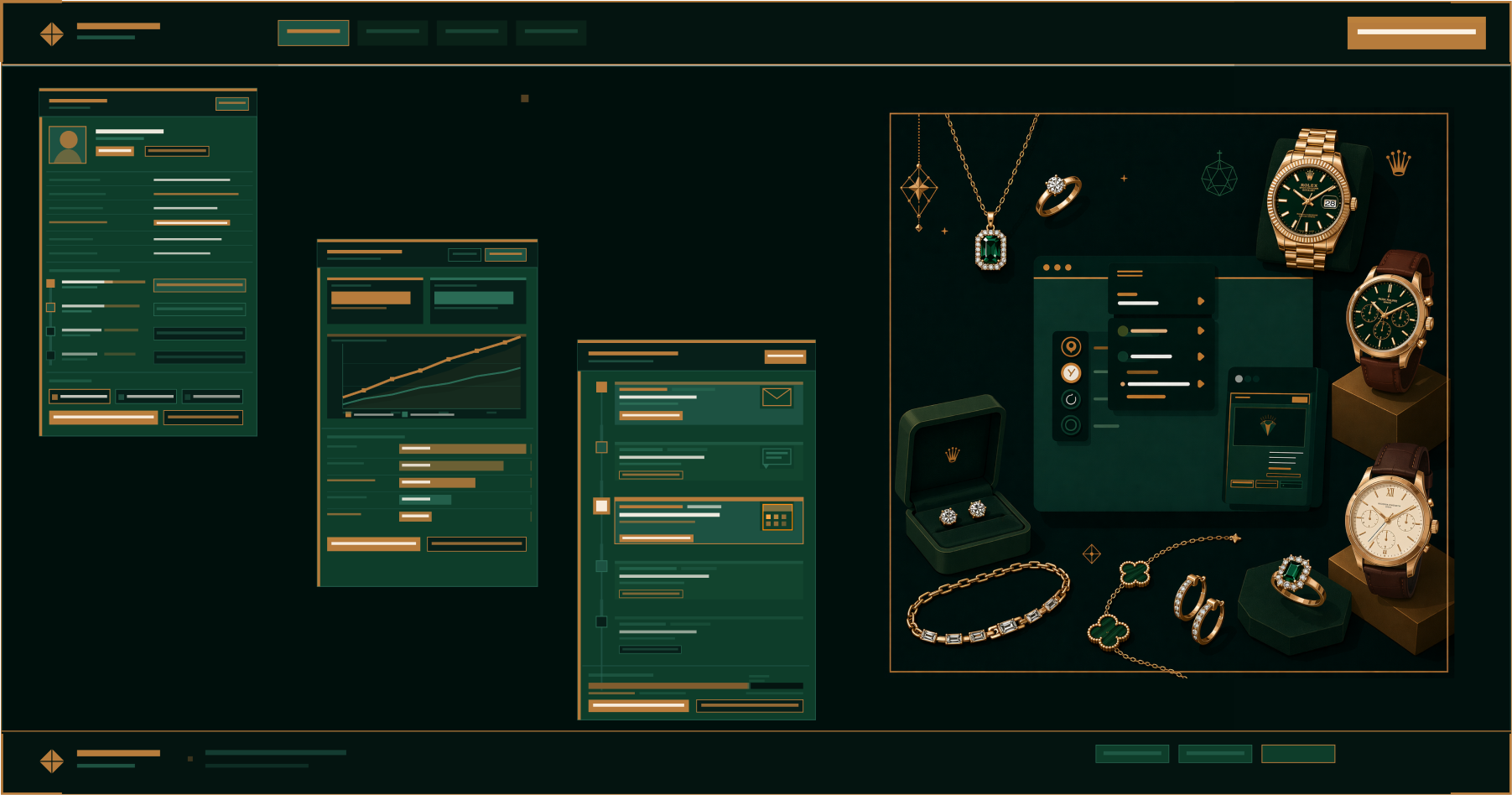
Jewelry CRM software helps retailers track every customer's purchase history, preferences, ring sizes, life events, and communication history in a single record so they can follow up at the right moment with the right message. For a Rolex authorised dealer, an independent boutique, or a multi-location chain, the difference between a one-time buyer and a lifelong client almost always comes down to whether your team remembered the details that made that customer feel known. A purpose-built jewelry CRM does not just store contact information. It surfaces the right customer at the right time and tells your team exactly what to say.
This guide covers how jewelry-specific CRM software works, what separates it from a generic contact database, and the exact steps jewelers use to convert first-time buyers into repeat clients. It draws on Luxare's work with more than 70 leading jewelers and on publicly available industry research on customer retention in fine jewelry retail.
Quick Answer: What is jewelry CRM software?
Jewelry CRM software is customer relationship management software built specifically for jewelry retailers. It stores ring sizes, metal preferences, wish lists, purchase history, service records, and key dates like anniversaries and birthdays. When integrated with your POS, it triggers personalized outreach automatically based on real customer data, helping jewelers retain high-value clients and grow repeat sales without relying on memory or manual effort.
Why Customer Retention Is the Most Overlooked Revenue Driver in Jewelry Retail
Most jewelry marketing budgets go toward finding new customers. The data says that is the wrong priority.
Only 9.9% of first-time luxury and jewelry customers make a second purchase within a year, according to Bluecore's benchmark report analysing over 100 retailers (Mobiloud). High price points and longer consideration cycles make jewelry one of the hardest retail categories for repeat purchases. But when those customers do come back, the revenue impact is significant. Bain and Company research shows that existing customers spend 67% more than new customers, and that spending differential compounds over time as the relationship deepens. (Anchor Group)
The cost of ignoring retention is equally clear. Improving retention by just 5% can increase profitability by anywhere between 25 and 95 percent, according to research from Bain and Company and Harvard Business School (Paylode). For fine jewelry, where transactions are tied to emotionally significant life events and average ticket sizes run into hundreds or thousands of dollars, a retained customer is not just a repeat sale. They are a referral, a review, and a relationship that compounds across every subsequent anniversary, birthday, and milestone.
The gap is not goodwill. Most jewelry customers would happily return to a store where they had a great experience. Research shows that 68% of customers leave a business not because of price or a bad experience, but due to perceived indifference (Salt Creative). Without a system that surfaces the right customer at the right moment, most jewelers leave that revenue on the table while spending money to find new clients they already have in their database.
How to Use Jewelry CRM Software to Retain Customers and Grow Repeat Sales
These steps work in sequence. The CRM is only as useful as the data you put into it and the follow-up habits you build around it.
Step 1: Build a Complete Customer Record From the First Transaction
The value of a jewelry CRM starts at intake. Every sale, repair drop-off, or consultation is an opportunity to capture information that will make every future interaction more effective.
A complete jewelry CRM record goes well beyond name, phone, and email. It captures ring sizes, metal and stone preferences, price range comfort, important dates like anniversaries and birthdays, and the specific context behind every purchase. A client who bought a sapphire pendant because it was her mother's birthstone is telling you exactly what to remember for next year.
Train every team member to treat the consultation note as seriously as the sale receipt. The two most valuable fields in any jewelry CRM record are the event date and the purchase context. Those two pieces of data are what make an automated follow-up feel like a personal one. If your current system does not capture these fields natively, or if your team is not filling them in consistently, your CRM is a contact list, not a retention engine.
Step 2: Set Up Personalised Outreach Around Life Events, Not Promotions
The most effective customer outreach in fine jewelry is timed to the customer's life, not the retailer's promotional calendar.
A generic Valentine's Day email goes to everyone and feels like it. A message that says "Hi James, your anniversary with Sarah is coming up in three weeks. We just received a new collection of sapphire pieces she might love, and I remembered she mentioned sapphires when you were last spring." That message converts because it is relevant, specific, and arrives at exactly the right moment.
The research on personalisation is consistent across every major study. McKinsey's analysis of personalisation across retail categories shows it most often drives 10 to 15 percent revenue lift, with company-specific gains ranging from 5 to 25 percent depending on sector and execution quality (McKinsey & Company). For fine jewelry, where purchases are already emotionally driven and clients are predisposed to return for milestone occasions, well-timed personalised outreach sits at the high end of that range.
According to Twilio Segment data, 60% of shoppers anticipate becoming repeat buyers following personalized shopping experiences, and 62% of business leaders report that personalisation efforts have directly improved customer retention (Contentful).
Jewelry CRM software built for the industry, like Luxare's CRM, allows you to set triggers based on recorded event dates so outreach goes out automatically, without your team having to scan manually through hundreds of records. At scale, across a database of hundreds or thousands of clients, this is only possible when the CRM handles the timing layer.
Step 3: Use Purchase History to Drive Intelligent Upsell and Cross-Sell
Every completed transaction in your database is a data point about what that customer values, what they spend, and what they might want next.
A client who purchased a yellow gold engagement ring is a strong candidate for a yellow gold wedding band six to twelve months later. A client who bought a diamond tennis bracelet is in the market for earrings to complement it. These are not cold outreach scenarios. They are warm conversations between your team and a customer who already trusts you, made possible when your CRM surfaces the right history at the right moment.
McKinsey research shows that 71% of customers expect personalized experiences, and 76% express frustration when brands fail to deliver them (Contentful). In the jewelry context, that frustration often looks like a client who visited your store twice for significant purchases and received a generic promotional email for a third-visit follow-up. They do not complain. They simply go somewhere else.
The key is making purchase history available at the point of conversation. When a customer walks in and your associate can pull up their full history, their preferences, their ring size, and the last item they bought before the customer finishes saying hello, the sale becomes easier, the average ticket grows, and the experience is fundamentally different from a generic retail interaction. Luxare's CRM surfaces this history directly alongside the POS transaction, so your team is never starting a conversation without context.
Step 4: Capture and Act on Wish Lists
A wish list in a jewelry CRM is not a passive feature. It is a sales trigger waiting for the right moment.
Customers who add items to a wish list are telling you exactly what they want. They are also telling you that they did not buy it yet, which means there is a reason, and that reason is often timing, not desire. A client who saved a particular piece three months ago may be waiting for a birthday, a bonus, or a nudge from a loved one who does not know what to buy.
Research shows that 56% of online customers are more likely to return to websites offering personalised product recommendations (Anchor Group), and wish list follow-up is the most targeted version of that trigger available to a jewelry retailer. When a piece on a customer's wish list goes on sale, becomes a final unit, or gets a price adjustment, that customer should hear about it before anyone else.
This requires a CRM that connects wish list data to inventory status in real time. Generic CRM tools do not do this. A jewelry-specific platform where the CRM and the inventory management system share a single database makes it possible without any manual reconciliation.
Step 5: Automate Post-Purchase Follow-Up to Build Loyalty Before the Next Occasion
The window immediately after a purchase is the most underused retention opportunity in jewelry retail.
A client who just bought an engagement ring is in an emotionally elevated state. They are grateful, excited, and almost certainly going to tell people about the experience. A follow-up message two or three days after the purchase, asking how the proposal went and sharing care instructions for the ring, turns a transaction into a relationship.
Most jewelry stores send nothing. The client walks out, the sale is closed, and the next contact is either a generic promotional email or silence until the client decides to come back. That silence is one of the leading drivers of customer drift. Research consistently shows that 68% of customers leave a business due to perceived indifference (Salt Creative), and for a retail category built on emotional connection, that indifference is particularly damaging.
The follow-up sequence that works in practice is a message two to three days post-purchase, a care reminder at thirty days, and a check-in at ninety days. None of these are promotional. All of them are relationship-building. When the anniversary approaches eight months later and the automated outreach lands in their inbox, it does not feel like a sales email. It feels like a jeweler who pays attention.
Step 6: Use CRM Data to Identify and Prioritise Your Highest-Value Clients
Not every customer in your database has the same revenue potential. A jewelry CRM lets you identify which clients have the highest lifetime value, the most frequent purchase history, and the strongest referral behaviour, so you can allocate your team's attention where it returns the most.
Companies using CRM tools see a 27% increase in customer retention, and 75% of organisations using CRM report significant improvements in customer satisfaction (CRM.org) The compounding effect is most visible at the top of your customer pyramid. Your top 10 to 15% of clients by lifetime spend deserve direct, personal outreach from a named associate, not a mass email. These are the clients who should receive a personal call when a new collection arrives, an invitation to a private trunk show, or early access to limited pieces.
Luxare's CRM analytics let retailers run this segmentation against actual transaction data, so the list reflects what customers have actually spent and how recently, not guesswork or intuition.
Step 7: Ensure Your CRM and POS Share a Single Database
This is a structural requirement, not a feature preference.
A CRM that sits separately from your POS creates a data problem from day one. Purchases logged in the POS do not update the CRM automatically. Follow-ups are triggered based on data that is one step removed from what actually happened. Wish lists saved online do not connect to in-store inventory. Associates toggle between systems and manually reconcile records, which they will not do consistently under the pressure of a busy sales floor.
CRM platforms deliver an average return of $8.71 for every $1 spent, according to industry research (CRM.org), but that return depends entirely on the quality and completeness of the data flowing into the system. A jewelry-specific platform where the CRM, POS, inventory, repair management, and e-commerce all operate on a single database eliminates the data gap problem at its root. Every transaction updates the customer record in real time. Every wish list item is connected to live inventory. Every service history and appraisal record is attached to the same profile your associate pulls up at the counter.
This is the core architectural difference between Luxare and a generic CRM bolted onto a retail system. The integration is not a feature. It is the foundation that every other capability in this guide depends on.
5 Mistakes Jewelers Make With Customer Relationship Management
Treating the CRM as a contact list, not a sales tool.
A database full of names and email addresses is not a CRM strategy. The value comes from the data attached to each record: purchase history, preferences, event dates, and communication logs. If your team is not capturing those details consistently at intake, the CRM cannot do anything useful with the contact.
Sending promotional emails instead of personalised outreach.
A mass email about a Mother's Day sale is not relationship management. It is advertising. 76% of customers say they become frustrated when brands fail to deliver personalized experiences (Contentful), and in fine jewelry, generic broadcasts erode the trust you built during the original purchase. The clients you most want to retain are the ones most likely to disengage from impersonal communication.
Ignoring the post-purchase window.
The forty-eight to seventy-two hours after a significant jewelry purchase are the highest-value retention window available. Most stores send nothing. A simple, warm follow-up message in that window costs nothing and does more for long-term loyalty than any subsequent promotional campaign.
Using a generic CRM not built for jewelry.
A general-purpose CRM captures contact details. A jewelry-specific CRM captures ring sizes, metal preferences, occasion history, wish lists, repair records, and purchase context. Those details are what make personalised outreach possible. Without them, the follow-up is still generic, regardless of how sophisticated the CRM platform is.
Letting CRM data go stale.
A customer whose anniversary date was recorded in 2022 but whose second purchase was never added to their record is a missed outreach opportunity every year after. CRM data requires ongoing maintenance. Assign someone ownership of data quality and review it quarterly. The system is only as powerful as the information you put into it.
What to Look for in Jewelry CRM Software
Luxare CRM: Purpose-built for jewelry and watch retailers. Customer records include purchase history, wish lists, ring sizes, metal preferences, service history, and life events. Fully integrated with POS, inventory, repair management, and e-commerce on a single database. No separate sync required. Trusted by Signet Jewelers, Helzberg, Roberto Coin, and 70+ leading jewelers.
Automated outreach based on event dates: The CRM should trigger messages based on recorded anniversaries, birthdays, and purchase-linked occasions, not require manual scheduling. This is the feature that turns a database into a retention engine.
Wish list connected to live inventory: When a client's wish list item goes on sale or reaches final stock, the system should flag it and prompt outreach automatically. This requires the CRM and inventory to share a single data source.
Segmentation by purchase history and lifetime value: You need to be able to identify your top-tier clients from your database and route different outreach to them. A CRM that cannot segment by transaction history is a contact list.
Repair and service history attached to the customer record: For fine jewelry retailers, a repair history is a relationship history. A client who has had three pieces serviced at your store is a deeply retained customer. Your team should know that before the conversation starts.
Omnichannel record unification: Online browsing behaviour, in-store purchases, and repair history should all be visible in the same customer record. A client who saved something online and then walked in should be recognised on both sides.
Explore Luxare's Jewelry CRM Solution>>
Frequently Asked Questions
What is jewelry CRM software?
Jewelry CRM software is customer relationship management software designed specifically for jewelry retailers. Unlike a general-purpose CRM, it stores jewelry-specific customer data including ring sizes, metal and stone preferences, wish lists, purchase history, service and repair records, and life event dates. When integrated with a jewelry POS, it allows retailers to trigger personalized follow-ups automatically based on real purchase data and recorded occasions, helping turn one-time buyers into repeat clients.
How does jewelry CRM software help increase repeat sales?
Jewelry CRM software increases repeat sales by making personalised, timely outreach possible at scale. When a customer's anniversary is thirty days away, the CRM surfaces that record and either prompts your associate or triggers an automated message referencing the occasion and the customer's actual preferences. This kind of specific, timed outreach converts at significantly higher rates than generic promotional campaigns. Research from Twilio Segment shows that 60% of shoppers anticipate becoming repeat buyers following personalized shopping experiences, and in fine jewelry, the occasion-based nature of purchases makes that timing lever especially powerful.
What is the difference between a jewelry CRM and a generic CRM?
A generic CRM stores contact details and communication logs. A jewelry-specific CRM stores purchase history, wish lists, ring sizes, metal preferences, repair records, appraisal documents, and life events. The most important difference is architectural: a jewelry CRM integrates with your POS and inventory system on a single database, so every transaction updates the customer record automatically. A generic CRM requires manual data entry or third-party sync, which creates data gaps and delays that make personalised outreach unreliable.
Can jewelry CRM software work for a single-location boutique?
Yes. Jewelry CRM software is useful at any scale, and the core retention mechanics, personalised follow-up, wish list management, event-based outreach, and purchase history visibility, are as relevant for a boutique with a few hundred clients as they are for a chain with thousands. The difference at a boutique is that a smaller database makes the data even more manageable, and the relationship-first culture of most independent jewelers means the personalized outreach the CRM enables will feel entirely natural to the clients receiving it.
How does jewelry CRM software work for Rolex authorised dealers?
Rolex authorised dealers have specific operational requirements: serialized watch inventory, warranty tracking, service history logging, and brand-specific reporting. A jewelry CRM for an authorised dealer needs to attach all of this to the customer record so that when a client comes in for a service, your associate can see the full ownership history, the original purchase date, the service intervals, and any communication log from previous visits. Luxare's platform is built for authorised dealer operations and handles these requirements natively, including the serialized inventory and compliance reporting that luxury watch retail requires.
What customer data should a jewelry CRM capture?
A jewelry CRM should capture: full name and contact details, purchase history with item descriptions and prices, ring sizes for every finger bought for, metal and stone preferences, price range comfort, life events including anniversaries and birthdays tied to purchases, service and repair history, wish list items, the context or occasion behind each purchase, and communication history including all follow-up contacts and their outcomes. These fields are what make the difference between a generic follow-up and one that feels personal and earns a response.
How does CRM software connect to a jewelry POS?
In a purpose-built platform like Luxare, the CRM and POS are not separate systems communicating through an integration. They share a single database. Every transaction completed at the POS updates the customer's CRM record instantly, including the item purchased, the price, the salesperson, and any notes captured during the sale. This eliminates the data gap that occurs when CRM and POS are separate products synced through a third-party connection, and ensures the customer record your associate sees on the floor reflects everything that has happened, including online purchases and repair drop-offs.
How long does it take to see results from jewelry CRM software?
Most jewelry retailers see measurable results within 60 to 90 days of implementing a CRM with automated follow-up workflows. The first results typically appear in the post-purchase follow-up window, where customers who previously heard nothing from the store begin responding to timely, personalized messages. Anniversary and event-based outreach produces results on the schedule of the events themselves, so the fuller picture becomes visible over the first six to twelve months as the CRM accumulates a complete event calendar for your client base.
How do I increase repeat purchases in my jewelry store without discounting?
The three approaches that grow jewelry repeat sales without discounting are personalized event-based outreach timed to the customer's life, wish list follow-up when a saved item changes in availability or price, and post-purchase relationship-building that makes clients feel known between visits. Existing customers who are retained through genuine relationship management, rather than promotional incentives, tend to spend significantly more over time, making the relationship investment far more durable than a discount strategy that trains clients to wait for price reductions.
Key Takeaways
- Jewelry CRM software tracks purchase history, wish lists, ring sizes, life events, and communication history in a single customer record, making personalised outreach possible at scale.
- Only 9.9% of first-time luxury and jewelry customers make a second purchase within a year (Mobiloud), which means the database of past buyers is a largely untapped revenue source for most jewelers.
- Companies using CRM tools see a 27% increase in customer retention on average (CRM.org), and those gains compound over time as the customer record grows richer.
- The most effective follow-up in jewelry retail is timed to the customer's life, not the retailer's promotional calendar. Anniversary and birthday outreach consistently outperforms generic campaigns.
- A CRM that sits separately from your POS creates data gaps. The most reliable approach is a platform where CRM, POS, inventory, and repair management share a single database.
- 68% of customers leave a business due to perceived indifference (Salt Creative), not price or product. A consistent post-purchase follow-up habit is the most cost-effective insurance against client drift.
Conclusion
The jewelers who grow repeat sales consistently are not necessarily the ones with the biggest marketing budgets or the most prominent locations. They are the ones whose clients feel remembered. When a customer walks in and your associate already knows what they bought, who they bought it for, and what occasion is coming up next, the relationship is the competitive advantage. No advertising budget can replicate that.
The honest difficulty is doing this consistently across a database of hundreds or thousands of clients. Memory fails. Staff turn over. Details captured carefully in one year are lost by the next. A jewelry-specific CRM is what makes the relationship feel personal at a scale your team could not manage manually.
McKinsey research consistently shows that personalisation drives 10 to 15 percent revenue lift for retailers who execute it well (McKinsey & Company), and the compounding effect in fine jewelry, where life events create natural, recurring purchase occasions year after year, makes that return even more significant over time. The technology that maintains customer records, surfaces them at the right moment, and triggers the right outreach is what turns a good customer experience into a retained client.
If you want to see how a jewelry-specific CRM works in practice, Luxare's team can walk you through a demo tailored to your store's operation and client base.
Trusted by 70+ leading jewelers, including Signet Jewelers, Helzberg, and Roberto Coin. Luxare's jewelry CRM is built into the same platform as your POS, inventory, and repair management, so every customer record stays complete and current without manual effort.
Book a free demo at Luxare >>
Related Resources
Best AI Clienteling Apps for Jewelry Retailers
Choosing the right AI clienteling app can help jewelry retailers deliver more personal service, strengthen VIP relationships, and turn follow-ups into sales. This guide compares five apps across seven key criteria, from POS integration and customer profiles to AI recommendations, repair history, omnichannel visibility, and measurable results for your store.
Best AI Clienteling Apps for Jewelry Retailers
Choosing the right AI clienteling app can help jewelry retailers deliver more personal service, strengthen VIP relationships, and turn follow-ups into sales. This guide compares five apps across seven key criteria, from POS integration and customer profiles to AI recommendations, repair history, omnichannel visibility, and measurable results for your store.
Best AI Clienteling Apps for Jewelry Retailers
Choosing the right AI clienteling app can help jewelry retailers deliver more personal service, strengthen VIP relationships, and turn follow-ups into sales. This guide compares five apps across seven key criteria, from POS integration and customer profiles to AI recommendations, repair history, omnichannel visibility, and measurable results for your store.
Jewelry ERP Software: What Manufacturers and Wholesalers Should Look For
Jewelry ERP software helps manufacturers and wholesalers manage metal and stone tracking, production workflows, wholesale orders, inventory, vendor coordination, and finances in one connected system. This guide explains the limitations of spreadsheets and generic ERPs, six essential features to evaluate, common selection mistakes, and a practical demo checklist to help businesses choose a jewelry-specific solution like Luxare.
Jewelry ERP Software: What Manufacturers and Wholesalers Should Look For
Jewelry ERP software helps manufacturers and wholesalers manage metal and stone tracking, production workflows, wholesale orders, inventory, vendor coordination, and finances in one connected system. This guide explains the limitations of spreadsheets and generic ERPs, six essential features to evaluate, common selection mistakes, and a practical demo checklist to help businesses choose a jewelry-specific solution like Luxare.
Jewelry ERP Software: What Manufacturers and Wholesalers Should Look For
Jewelry ERP software helps manufacturers and wholesalers manage metal and stone tracking, production workflows, wholesale orders, inventory, vendor coordination, and finances in one connected system. This guide explains the limitations of spreadsheets and generic ERPs, six essential features to evaluate, common selection mistakes, and a practical demo checklist to help businesses choose a jewelry-specific solution like Luxare.
Jewelry CRM With Inventory Integration: Connecting Client Profiles to What's Actually in Stock
A jewelry CRM is only as useful as the inventory data behind it. Learn how connecting client profiles, preferences, wish lists, repairs, and live stock can help retailers personalize outreach and turn more opportunities into sales.
Jewelry CRM With Inventory Integration: Connecting Client Profiles to What's Actually in Stock
A jewelry CRM is only as useful as the inventory data behind it. Learn how connecting client profiles, preferences, wish lists, repairs, and live stock can help retailers personalize outreach and turn more opportunities into sales.
Jewelry CRM With Inventory Integration: Connecting Client Profiles to What's Actually in Stock
A jewelry CRM is only as useful as the inventory data behind it. Learn how connecting client profiles, preferences, wish lists, repairs, and live stock can help retailers personalize outreach and turn more opportunities into sales.


