

Aug 3, 2026

7 min read
AI-Driven Production Planning: How Jewelry Manufacturers Can Use ERP to Balance Custom Orders, Lab-Grown Demand, and Rising Gold Prices
AI-driven ERP helps jewelry manufacturers balance custom orders, lab-grown demand, and gold price volatility. Here's how Luxare supports smarter production planning.
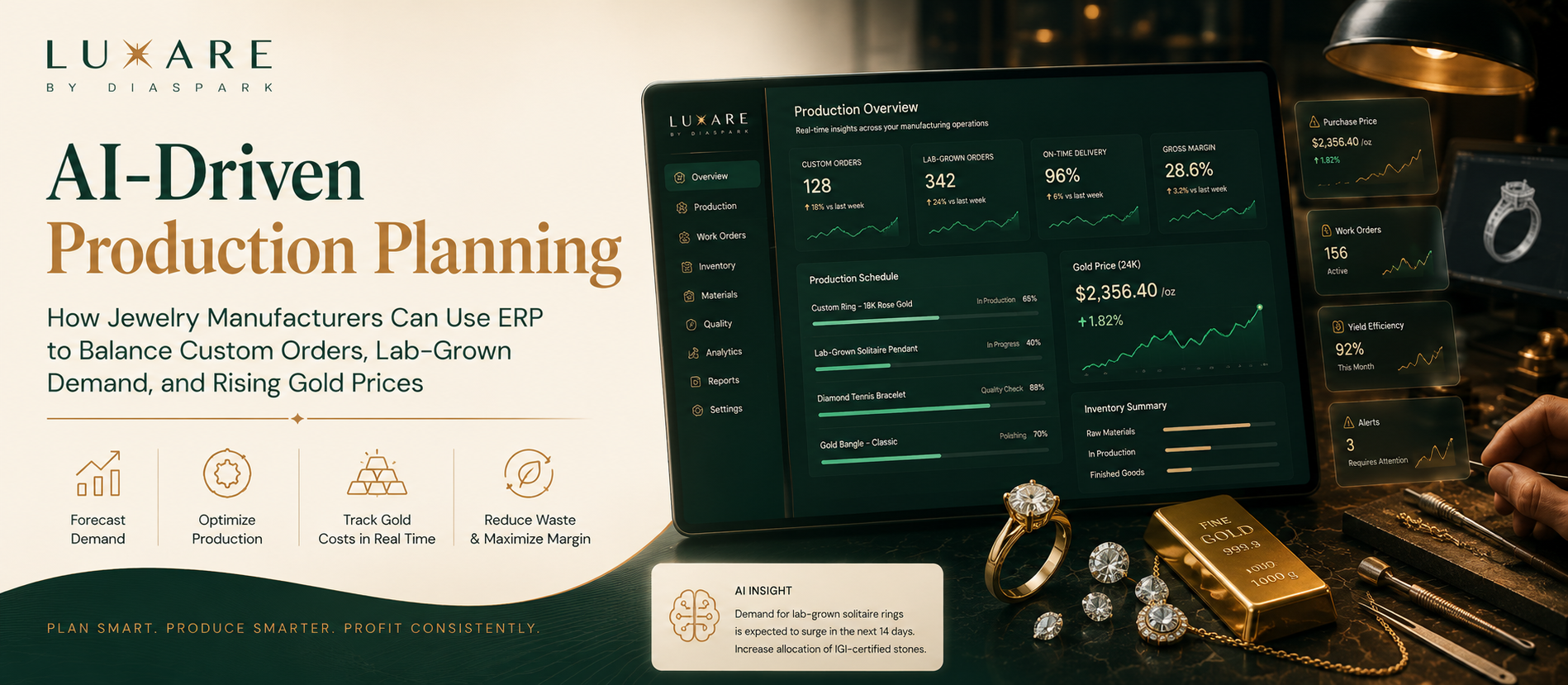
Jewelry manufacturing runs on balance: creativity against precision, tradition against innovation, and now, fast-changing customer demand against volatile global markets. That balance has gotten harder to hold.
Custom orders and personalization keep climbing. Customers don't just want a diamond ring, they want a lab-grown diamond in a pear shape, engraved initials, and a rose-gold band resized for comfort. At the same time, gold prices have swung unpredictably as interest rates, currency shifts, and geopolitical tension push the metal up and down.
Personalization at scale plus raw material volatility is where old systems and manual spreadsheets stop being enough. This guide covers how AI-driven production planning and ERP make that manageable, where manufacturers most often get it wrong, and how tools like Luxare fit into that.
Quick Answer: AI-driven ERP helps jewelry manufacturers balance custom orders, lab-grown demand, and gold price volatility by centralizing real-time inventory, cost tracking, and demand forecasting in one system. It slots custom orders into production without disrupting bulk runs, and updates costs the moment gold or labor prices move.
What's Changing in Jewelry Manufacturing
Custom Orders as the New Normal
Personalization has moved from a nice-to-have to a baseline expectation. Customers want unique engravings, stone swaps, custom-fitted bands. For manufacturers, this means mass production runs alone won't cut it anymore. Custom orders have to slot into production schedules without throwing off standard workflows.
Lab-Grown Diamonds Redefining Demand
Lab-grown diamonds cost less to produce and appeal to younger, more eco-conscious buyers, and they now account for a large and growing share of engagement rings sold. This complicates production planning in a few concrete ways. Manufacturers need to balance mined and lab-grown supply. Certificates and grading categories differ between the two, including the "premium" versus "standard" lab-grown classifications GIA has introduced. Marketing and SKU management have to adapt to both.
Gold Price Volatility
Gold has traditionally been a safe-haven asset, but price swings have sharpened with inflation, interest rate moves, and geopolitical events. Without real-time tracking and cost analysis, manufacturers risk mispricing products in either direction, and both are dangerous in a competitive market.

How AI-Driven ERP Solves Jewelry Production Planning
ERP systems have long centralized manufacturing operations, but jewelry ERP has to do more: track serialized inventory where every stone is unique, manage custom requests, and calculate costs for metals and labor that shift daily. Add AI to that layer and it stops just recording what happened, it starts predicting what's coming.
Step 1: Predict Demand Before It Hits
By analyzing past sales, current orders, and market sentiment, AI can forecast demand spikes. Bracelets tend to trend before Valentine's Day. Lab-grown solitaire rings surge during engagement season. Gold bangles see higher demand around Diwali in India or the Jewish High Holidays. This helps manufacturers allocate resources ahead of the surge instead of reacting to it.
Step 2: Optimize Scheduling
Custom jobs often knock bulk production off schedule when they're handled manually. AI can automatically prioritize and schedule them without delaying bulk orders, for example, scheduling a ring resizing alongside polishing jobs already in progress. Luxare's production planning module handles this slotting automatically rather than leaving it to a manager's judgment call.
Step 3: Track Gold and Labor Costs in Real Time
Real-time cost tracking recalculates margin the moment metal or labor prices shift, so pricing decisions are based on current numbers rather than last month's.
Step 4: Forecast Raw Material Needs Before Prices Move
AI models that factor in gold price trends can flag better windows for purchasing or hedging raw materials, rather than buying reactively whenever stock runs low.
Step 5: Reduce Waste Through Smarter Allocation
Smarter allocation of metals and stones reduces scrap and misallocation. ERP with AI improves this over time by learning from past production runs.
Step 6: Give Retailers and Wholesalers Real Visibility
With AI-enabled ERP, manufacturers can keep retailers and wholesalers informed automatically: real-time updates on production stages, expected completion, and certificate attachments.
Common Mistakes in Jewelry Production Planning
Pricing off last month's gold cost.
A cost sheet that updates monthly means every quote in between is built on a stale number. Gold can move enough in two weeks to erase the margin on a job priced at the start of the month.
Treating custom orders as exceptions.
When custom work sits outside the main production system, it gets scheduled by whoever has time to deal with it, not by what fits the line. That's how custom jobs end up delaying bulk runs instead of running alongside them.
Not separating lab-grown from mined diamonds in costing.
Lab-grown and mined stones carry different cost structures and certification paths. Lumping them into one inventory category makes margin reporting inaccurate for both.
Relying on vendor relationships instead of vendor data.
A vendor who was reliable two years ago isn't automatically the fastest option today. Without delivery-time and defect-rate data, manufacturers default to habit instead of the best current option.
Waiting for month-end to find out margins shrank.
By the time a monthly report shows a margin problem, the jobs that caused it have already shipped. Real-time visibility catches it while there's still time to adjust.

A Production Planning Scenario
Picture a mid-sized jewelry manufacturer supplying both US retailers and Indian wholesalers.
In September, gold prices spike 5% in two weeks. At the same time, custom orders for engraved lab-grown solitaire rings surge ahead of holiday engagement season, and wholesalers in Canada request bulk bangles for Diwali.
Without ERP, production managers are juggling spreadsheets, making last-minute vendor calls, and often miscalculating costs. Orders get delayed, margins shrink, customers get frustrated.
With AI-driven ERP like Luxare, gold costs update in real time and flow into pricing and production forecasts automatically. Custom jobs get slotted into schedules intelligently, without slowing down bulk runs. Vendor performance data points to which supplier can deliver lab-grown stones fastest. Reports show managers exactly how rising gold costs are affecting margins, and where to adjust.
Tools and Resources
Luxare ERP, featured. Order management, vendor management, serialized inventory tracking, AI-driven production forecasting, and real-time cost visibility, built specifically for jewelry manufacturing and wholesale.
GIA Lab-Grown Diamond Grading Standards, a reference for the certification and grading distinctions between lab-grown and mined stones.
Live Gold Spot Price Feed, the real-time metals pricing input any live cost-tracking system depends on.
Vendor Performance Tracking, whatever system tracks delivery times and defect rates by vendor is what replaces habit-based vendor selection with data.
If you are still tracking gold prices on spreadsheets or treating custom orders as exceptions to your production schedule, the next step is simple:
Frequently Asked Questions
What is AI-driven ERP for jewelry manufacturers?
AI-driven ERP for jewelry manufacturers is production and resource planning software that uses AI to forecast demand, schedule custom and bulk orders, track raw material costs in real time, and manage vendor relationships. Unlike generic manufacturing ERP, it's built to handle serialized inventory where every stone is unique, along with jewelry-specific needs like certificate tracking and precious metal cost fluctuation.
How does ERP help jewelry manufacturers manage custom orders?
ERP systems built for jewelry can slot custom orders into existing production schedules automatically, based on machine and staff availability, rather than requiring a manager to manually rearrange the line. This keeps custom work from delaying bulk production runs, which is one of the most common bottlenecks in jewelry manufacturing.
How can jewelry manufacturers protect margins from gold price volatility?
The most direct way is real-time cost tracking that recalculates production costs as gold and labor prices move, rather than relying on a cost sheet that updates weekly or monthly. Some AI-enabled systems also flag favorable windows for purchasing or hedging raw materials based on price trend data.
What's the difference between generic manufacturing ERP and jewelry-specific ERP?
Generic manufacturing ERP typically tracks inventory by SKU and assumes standardized units. Jewelry-specific ERP is built around serialized inventory, where every stone and finished piece is unique, along with certificate tracking, precious metal cost fluctuation, and the mix of custom and bulk orders typical of jewelry production.
How does AI improve production forecasting for jewelry manufacturers?
AI models analyze historical sales, current order volume, and seasonal patterns to predict demand spikes, for example ahead of engagement season or a regional holiday like Diwali. That lets manufacturers allocate materials and labor ahead of demand rather than reacting after orders come in.
Can ERP track lab-grown and mined diamonds differently?
Yes, and it should. Lab-grown and mined diamonds carry different cost structures, certification categories, and grading standards, including the separate "premium" and "standard" lab-grown classifications GIA has introduced. Tracking them as a single inventory category makes margin reporting inaccurate for both.
Does Luxare's ERP work for wholesalers as well as manufacturers?
Yes. Luxare's manufacturing and wholesale suite covers order entry, vendor relationships, and inventory across the supply chain, in addition to production planning, so it extends the same system from the production floor to wholesale distribution.
How long does it take to implement AI-driven ERP in a jewelry manufacturing business?
Implementation timelines vary based on the number of production sites, existing data quality, and whether the business is migrating from spreadsheets or another system entirely.
Key Takeaways
- Static cost sheets can't keep up with daily gold price movement, and pricing off stale numbers is one of the most common margin leaks in jewelry manufacturing.
- Custom orders derail bulk production when they're handled as exceptions instead of being scheduled inside the same system.
- Lab-grown and mined diamonds need separate cost and certification tracking, not a shared inventory category.
- Vendor selection should run on performance data, delivery times and defect rates, not on habit or relationship alone.
- AI-driven ERP turns production planning from reactive to proactive by forecasting demand and flagging cost risk before it hits the bottom line.
The Future of Jewelry Manufacturing with AI
More manufacturers are expected to adopt AI-driven ERP as standard practice, including:
- AI-powered pricing engines that update retail prices daily based on gold fluctuations.
- Blockchain integration for stone provenance and sustainability tracking.
- Customer-facing portals where retailers can track their orders in real time.
- Predictive analytics for regional demand, for example forecasting lab-grown sales in the US against mined diamond sales in India.
Manufacturers who adopt these capabilities early will be better positioned to handle volatility instead of just reacting to it.
Conclusion
Jewelry manufacturing today means handling custom orders, lab-grown demand, and rising gold prices at once, without losing efficiency or profitability. Systems built for an earlier, simpler production model can't keep up.
None of this is easy to execute consistently by hand. Tracking gold prices daily, separating lab-grown and mined inventory, and slotting custom work into a production line all take real discipline, and it's easy for any one of them to slip when the floor is busy.
That's where the right system closes the gap. Luxare by Diaspark builds ERP around the jewelry industry's actual operating reality, with real-time cost tracking, demand forecasting, and custom order scheduling built specifically for jewelry manufacturing and wholesale.
Precision matters for the product. It matters just as much for the business behind it.
Trusted by Jewelry Manufacturers and Wholesalers
See how Luxare's AI-driven ERP tracks gold costs in real time and slots custom orders into your production schedule.
Related Resources
Jewelry CRM With Inventory Integration: Connecting Client Profiles to What's Actually in Stock
A jewelry CRM is only as useful as the inventory data behind it. Learn how connecting client profiles, preferences, wish lists, repairs, and live stock can help retailers personalize outreach and turn more opportunities into sales.
Jewelry CRM With Inventory Integration: Connecting Client Profiles to What's Actually in Stock
A jewelry CRM is only as useful as the inventory data behind it. Learn how connecting client profiles, preferences, wish lists, repairs, and live stock can help retailers personalize outreach and turn more opportunities into sales.
Jewelry CRM With Inventory Integration: Connecting Client Profiles to What's Actually in Stock
A jewelry CRM is only as useful as the inventory data behind it. Learn how connecting client profiles, preferences, wish lists, repairs, and live stock can help retailers personalize outreach and turn more opportunities into sales.
Diamond Inventory Software: What Jewelry Retailers Need Beyond Basic Stock Counts
Basic stock counts fail diamonds. Real inventory management needs serialization down to individual stones, certification data attached to each record, live metal/diamond pricing, and separate tracking for consignment vs. owned stock. Reconciliation should be routine, not annual. Learn what jewelry retailers actually need beyond quantity counts—and where generic POS falls short.
Diamond Inventory Software: What Jewelry Retailers Need Beyond Basic Stock Counts
Basic stock counts fail diamonds. Real inventory management needs serialization down to individual stones, certification data attached to each record, live metal/diamond pricing, and separate tracking for consignment vs. owned stock. Reconciliation should be routine, not annual. Learn what jewelry retailers actually need beyond quantity counts—and where generic POS falls short.
Diamond Inventory Software: What Jewelry Retailers Need Beyond Basic Stock Counts
Basic stock counts fail diamonds. Real inventory management needs serialization down to individual stones, certification data attached to each record, live metal/diamond pricing, and separate tracking for consignment vs. owned stock. Reconciliation should be routine, not annual. Learn what jewelry retailers actually need beyond quantity counts—and where generic POS falls short.
Still Running Jewelry Production on Spreadsheets? Meet the Cloud-Native, AI-Powered ERP Built for Fine Jewelry Manufacturing
Jewelry manufacturers often struggle with outdated ERP systems or spreadsheets that can't handle the complexity of serialized, precious-metal goods. This guide explores a cloud-native jewelry ERP designed with built-in intelligence, highlighting how the right platform can transform your operations.
Still Running Jewelry Production on Spreadsheets? Meet the Cloud-Native, AI-Powered ERP Built for Fine Jewelry Manufacturing
Jewelry manufacturers often struggle with outdated ERP systems or spreadsheets that can't handle the complexity of serialized, precious-metal goods. This guide explores a cloud-native jewelry ERP designed with built-in intelligence, highlighting how the right platform can transform your operations.
Still Running Jewelry Production on Spreadsheets? Meet the Cloud-Native, AI-Powered ERP Built for Fine Jewelry Manufacturing
Jewelry manufacturers often struggle with outdated ERP systems or spreadsheets that can't handle the complexity of serialized, precious-metal goods. This guide explores a cloud-native jewelry ERP designed with built-in intelligence, highlighting how the right platform can transform your operations.


