

Sep 18, 2026

10 mins
Diamond Inventory Software: What Jewelry Retailers Need Beyond Basic Stock Counts
Basic stock counts fail diamonds. Real inventory management needs serialization down to individual stones, certification data attached to each record, live metal/diamond pricing, and separate tracking for consignment vs. owned stock. Reconciliation should be routine, not annual. Learn what jewelry retailers actually need beyond quantity counts—and where generic POS falls short.
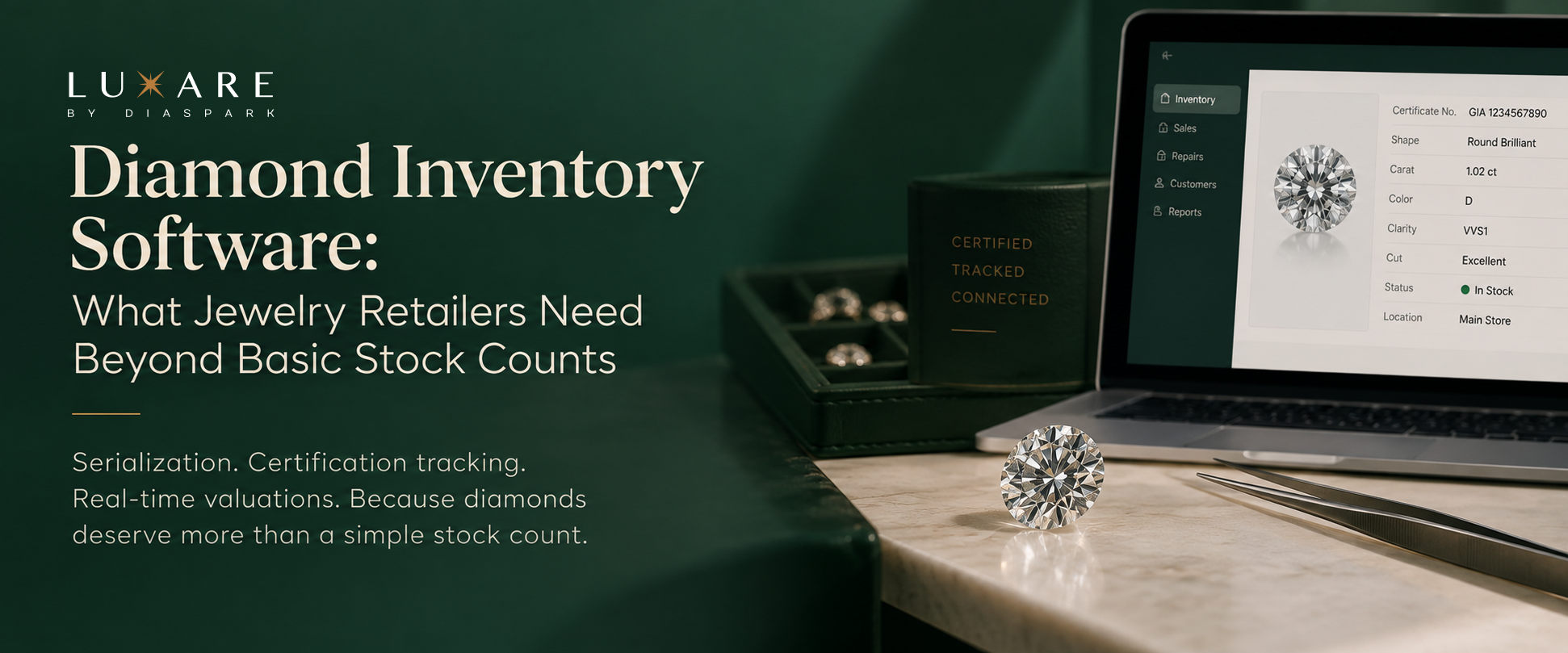
Counting diamonds is not the same as tracking them. Legacy jewelry software and generic retail systems can tell you that you have twelve loose stones and eighteen solitaire rings. It cannot tell you which stone is which, what it is certified at, what it costs against today's metal and diamond pricing, or where it sits in a consignment or memo cycle. Diamond inventory software is built to answer those questions, and that is what separates it from basic stock counting. Cloud-based, AI-powered platforms have made this kind of piece-level accuracy realistic even for a single-location boutique, not just large chains with dedicated inventory teams. This guide walks through the specific capabilities that matter for independent boutiques and multi-location retailers alike, the mistakes that come from treating diamonds like any other SKU, and what to look for before you commit to a system.
Why Basic Stock Counts Fall Short for Diamonds
A generic retail POS treats inventory as fungible. Ten identical t-shirts are interchangeable, so quantity is the only variable that matters. Diamonds do not work that way. Two stones that look nearly identical on a tray can differ in certified clarity, origin, and value by thousands of dollars, and once a certificate number is disconnected from the physical stone, that difference becomes a matter of memory and paperwork rather than a searchable record.
This gap shows up most visibly at reconciliation time. Average retail inventory shrinkage sits at approximately 1.6 percent of sales across general retail. Jewelry absorbs that same percentage very differently: losing one loose diamond or one solitaire ring can represent thousands of dollars in a single incident, in a way that losing a t-shirt or a phone case never does. The global jewelry market is projected at approximately $377 billion in 2025, growing at a 5.4 percent CAGR through 2031 (Mordor Intelligence, 2026). A market that size, built on high per-unit value and thin per-store margins, cannot afford inventory systems that were designed for high-volume, low-value goods.

What Diamond Inventory Software Actually Needs to Do
1. Serialize Every Stone, Not Just Every Style
A style number tells you what you sold. A serial number tells you which physical piece you sold. For diamonds, that distinction is the entire point. Every loose stone and every stone-set piece needs its own unique identifier tied to a barcode or QR code so that scanning intake, transfer, and sale creates a traceable chain from vendor receipt to customer. Without this, "12 in stock" is a number you have to trust rather than a number you can prove.
2. Attach Certification and Grading Data to the Record, Not a Filing Cabinet
GIA, AGS, and IGI certificate numbers should live on the inventory record itself, searchable and printable at the point of sale. When a customer asks about clarity or origin, the answer should come up on screen in seconds, not from a physical folder in the back office. This also matters for insurance appraisals and for any later resale or trade-in, where the certificate is the difference between a documented stone and an undocumented one.
3. Price Against Live Metal and Diamond Market Data
Static cost-of-goods figures go stale fast when gold sits above $3,000 an ounce and diamond pricing shifts with lab-grown supply. Inventory software built for the category should let you set pricing rules by metal type, karat, and stone attributes and update valuations as market prices move, rather than requiring a manual repricing pass every time the market shifts.
4. Track Consignment and Memo Stock Separately From Owned Inventory
Estate pieces, consignment stock, and memo goods from vendors are not the same asset as inventory you have paid for outright, and treating them identically in your system creates real accounting and audit problems. The software should flag ownership status on every piece, track consignor or vendor terms, and separate consigned value from owned value in reporting, so a walkthrough of your books actually reflects what you own versus what you are holding.
5. Sync Inventory in Real Time Across Every Channel and Location, in the Cloud
A single style might exist across a showroom floor, an online listing, and a second location's safe. If a piece sells in-store and the online listing does not update instantly, you risk an oversell that damages a customer relationship before it even starts. A cloud-based system keeps every location and channel reading from the same live record, so real-time sync across channels and locations is not a convenience feature for diamond inventory; it is the only way to avoid promising a stone that is no longer there.
6. Build in Smart Reconciliation and AI-Assisted Shrinkage Reporting
Month-end counts should confirm what the system already knows, not surface surprises. Look for software with smart reconciliation reporting that flags stones that have not moved in a defined window, surfaces aging inventory automatically, and ties physical counts back to the serialized record without a manual cross-check. This is where the gap between a generic POS and diamond-specific inventory software is most visible: one system tells you something is wrong after the fact; the other is built to prevent the gap from opening in the first place.
7. Let AI Do the Work of Watching Your Inventory for You
Luxare's entire platform, including inventory, POS, CRM, and repair, is built on Esme AI, the intelligence layer behind Luxare's AI capabilities across the ecosystem. For inventory specifically, that means smart alerts on aging or slow-moving diamonds, AI-assisted matching between a customer's stated preferences and what is actually sitting in the case, and predictive signals on what to reorder before a category runs thin. Rather than a separate AI add-on, it is the same intelligence layer running underneath every Luxare module, so an inventory insight can inform a clienteling conversation on the sales floor without anyone re-entering data.

Common Mistakes Jewelry Retailers Make With Diamond Inventory
- Treating serialized items like standard SKUs. A spreadsheet column for "quantity" works for earrings sold as a pair in a fixed style. It does not work for a loose diamond where every unit is unique.
- Disconnecting certificates from the inventory record. A certificate that lives in a binder instead of on the digital record is a certificate that will eventually get separated from its stone, especially across staff turnover or a busy holiday season.
- Reconciling only at year-end. Annual reconciliation catches problems long after they happened, when the trail has gone cold. Monthly or even weekly reconciliation against a serialized record catches discrepancies while there is still a chance to trace the cause.
- Ignoring consignment and memo exposure in reporting. Treating consigned stones as owned inventory inflates your asset position and can create real problems at tax time or during an insurance claim.
- Assuming a generic retail platform will "grow into" diamond tracking. Serialization, certification fields, and matrix inventory for stone-set variants are either native to a system or they are workarounds, and workarounds tend to break down exactly when volume increases.
What This Looks Like in Practice
Hing Wa Lee Jewelers, a fine jewelry group on the West Coast, moved to Luxare's platform while expanding operations and needing more accurate reporting across inventory and sales. Jacquelyn Chiong, VP of Merchandise at Hing Wa Lee Jewelers, said:
"We came across Luxare by Diaspark when we were expanding and needed a system that was more intuitive. My favorite part of Luxare is being able to build reports that optimize my needs, and I would certainly recommend it to others." — Jacquelyn Chiong, VP of Merchandise, Hing Wa Lee Jewelers

Tools to Support Diamond Inventory Accuracy
- Luxare's retail inventory module: Serialized tracking, certificate storage, matrix inventory, and Esme AI-powered smart alerts, built specifically for jewelry and watch retailers on a single cloud platform alongside POS and reporting.
- Barcode or RFID scanning hardware: Physical intake and transfer scanning is what makes serialization practical day to day rather than a manual data entry task.
- GIA Report Check: A free tool from GIA for verifying that a certificate number matches GIA's own records, useful as a cross-check when receiving stones with attached certification.
- Spreadsheet software: Still common as a stopgap for very small operations, but worth naming plainly as the baseline this guide is arguing you should move beyond for anything past a handful of SKUs.
Key Takeaways
- Diamonds need to be tracked individually, with a unique serial number per stone, not counted as interchangeable SKUs.
- Certification and grading data belongs on the digital inventory record, not in a separate physical file.
- Pricing should reflect live metal and diamond market conditions, not a static cost figure set once and left alone.
- Consignment and memo stock needs separate visibility from owned inventory in both tracking and reporting.
- Reconciliation works best as a regular habit, not an annual event, and it should tie back to a serialized record rather than a manual count.
- A generic retail platform can be adapted to hold some of this data, but serialization, certification fields, and diamond-specific reporting tend to work better as native capabilities than as workarounds.
- A cloud-based, AI-powered platform can run smart reconciliation and reorder alerts in the background, catching issues before they turn into a write-off at month-end.
Where This Leaves Your Next Step
None of this requires replacing your entire operation overnight. It starts with an honest look at whether your current system can answer a simple question: for any stone in your inventory right now, can you pull up its certificate, its cost basis, and its ownership status in under a minute? If the answer involves a filing cabinet or a phone call to check a spreadsheet, that is the gap diamond inventory software is built to close.
Luxare's retail platform brings serialized inventory, certificate tracking, and real-time reporting into the same system used for POS and customer records, built specifically around how jewelry and watch retailers actually operate rather than adapted from generic retail software after the fact.
See how Luxare handles serialized diamond inventory in a live demo
Book a Free Demo →
Frequently Asked Questions
What is diamond inventory software?
Diamond inventory software is inventory management technology built specifically for tracking individual diamonds and diamond-set jewelry, rather than treating stock as generic, interchangeable units. It handles serialization down to the individual stone, attaches certification and grading data to each record, and supports pricing that reflects live metal and diamond market conditions.
How is diamond inventory software different from general jewelry inventory management software?
Jewelry inventory management software is the broader category, covering metal, gemstones, and finished pieces across a retail operation. Diamond inventory tracking is a specific requirement within that category, focused on serializing loose stones and stone-set pieces individually and attaching certification data that general merchandise does not need.
Do I need serialized inventory if I run a small independent boutique?
Yes, and arguably more so than a large chain. A small boutique has less room to absorb the loss of a single high-value stone, and fewer staff members to catch a discrepancy before it compounds. Serialization scales down to a single-location operation just as well as it scales up to a multi-store chain.
Can diamond inventory software handle consignment and memo stock?
Software built for the category should, yes. Look specifically for the ability to flag ownership status per item and separate consigned or memo value from owned inventory in your reporting, since this affects both your accounting accuracy and your audit trail.
How often should I reconcile diamond inventory?
Monthly reconciliation is a reasonable baseline for most retailers, with weekly spot checks on high-value or frequently handled pieces. Waiting until year-end to reconcile makes it far harder to trace when and how a discrepancy happened.
Does diamond inventory software integrate with GIA or AGS certification databases?
Capability varies by vendor, and this is worth confirming directly with any vendor you evaluate rather than assuming. At minimum, the software should let you store and search certificate numbers on the inventory record; direct database integration is a further capability some platforms offer and others do not.
What happens to diamond inventory tracking when I sell across multiple locations or online?
Without real-time sync, a stone sold in one location or channel can still show as available in another, creating an oversell that is especially damaging for a one-of-a-kind piece. Multi-location and omnichannel sync should be treated as a requirement, not an optional add-on, for any retailer selling diamonds across more than one channel.
How much does diamond inventory software cost?
Pricing varies based on the number of locations, transaction volume, and which modules you need beyond inventory, such as POS, CRM, or repair. Most vendors, including Luxare, price this on a custom basis tied to store count and feature scope rather than a flat published rate.
Does AI actually help with diamond inventory management?
Yes, in practical ways beyond the buzzword. AI-assisted inventory tools can flag slow-moving stones, predict reorder needs by category, and match available inventory to a customer's stated preferences automatically. Luxare's platform runs this through Esme AI, the same intelligence layer behind clienteling, POS, and reporting, so inventory insight and sales-floor recommendations stay connected instead of living in separate systems.
Related Resources
AI-Driven Production Planning: How Jewelry Manufacturers Can Use ERP to Balance Custom Orders, Lab-Grown Demand, and Rising Gold Prices
AI-driven ERP helps jewelry manufacturers balance custom orders, lab-grown demand, and gold price volatility. Here's how Luxare supports smarter production planning.
AI-Driven Production Planning: How Jewelry Manufacturers Can Use ERP to Balance Custom Orders, Lab-Grown Demand, and Rising Gold Prices
AI-driven ERP helps jewelry manufacturers balance custom orders, lab-grown demand, and gold price volatility. Here's how Luxare supports smarter production planning.
AI-Driven Production Planning: How Jewelry Manufacturers Can Use ERP to Balance Custom Orders, Lab-Grown Demand, and Rising Gold Prices
AI-driven ERP helps jewelry manufacturers balance custom orders, lab-grown demand, and gold price volatility. Here's how Luxare supports smarter production planning.
Still Running Jewelry Production on Spreadsheets? Meet the Cloud-Native, AI-Powered ERP Built for Fine Jewelry Manufacturing
Jewelry manufacturers often struggle with outdated ERP systems or spreadsheets that can't handle the complexity of serialized, precious-metal goods. This guide explores a cloud-native jewelry ERP designed with built-in intelligence, highlighting how the right platform can transform your operations.
Still Running Jewelry Production on Spreadsheets? Meet the Cloud-Native, AI-Powered ERP Built for Fine Jewelry Manufacturing
Jewelry manufacturers often struggle with outdated ERP systems or spreadsheets that can't handle the complexity of serialized, precious-metal goods. This guide explores a cloud-native jewelry ERP designed with built-in intelligence, highlighting how the right platform can transform your operations.
Still Running Jewelry Production on Spreadsheets? Meet the Cloud-Native, AI-Powered ERP Built for Fine Jewelry Manufacturing
Jewelry manufacturers often struggle with outdated ERP systems or spreadsheets that can't handle the complexity of serialized, precious-metal goods. This guide explores a cloud-native jewelry ERP designed with built-in intelligence, highlighting how the right platform can transform your operations.
Clienteling vs CRM for Jewelry Stores: What Is the Difference?
Think your POS CRM is enough? Discover why basic record-keeping might be costing your jewelry store sales, and how active clienteling turns passive data into proactive, revenue-driving relationships.
Clienteling vs CRM for Jewelry Stores: What Is the Difference?
Think your POS CRM is enough? Discover why basic record-keeping might be costing your jewelry store sales, and how active clienteling turns passive data into proactive, revenue-driving relationships.
Clienteling vs CRM for Jewelry Stores: What Is the Difference?
Think your POS CRM is enough? Discover why basic record-keeping might be costing your jewelry store sales, and how active clienteling turns passive data into proactive, revenue-driving relationships.


