

Jun 12, 2026

16 mins
How Jewelry Stores Can Automate Customer Follow-Ups (Without Feeling Robotic)
Automating customer follow-ups doesn’t mean sacrificing the personal touch jewelry buyers expect. By leveraging smart CRM tools and timely data, jewelry stores can seamlessly automate birthday reminders, bridal milestones, and post-purchase check-ins—driving repeat sales and building lasting loyalty completely on autopilot without ever sounding robotic.
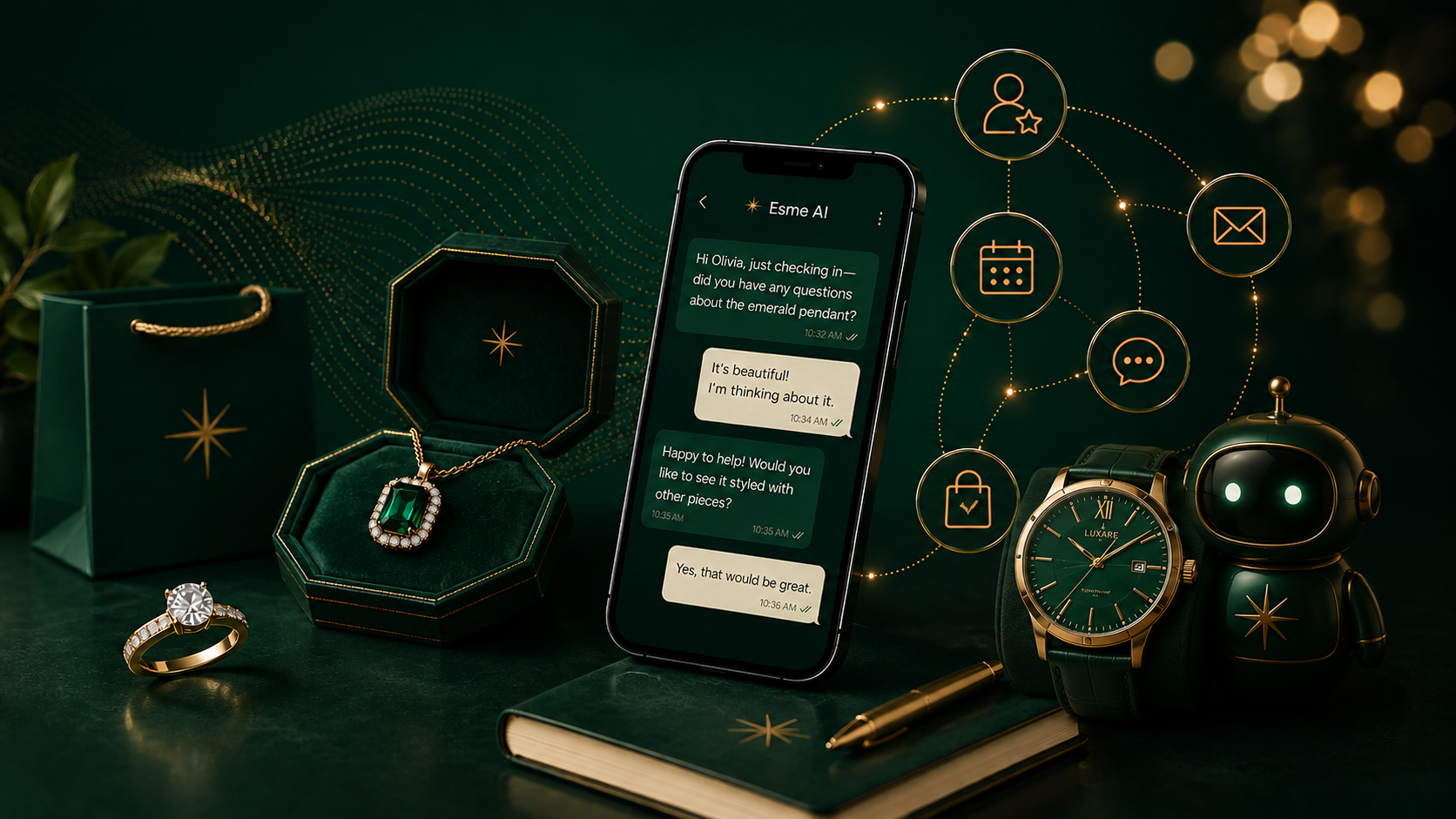
Automating customer follow-ups in a jewelry store does not mean sending generic emails that feel like spam. Done right, it means the right message reaches the right customer at the right moment, whether that is a birthday reminder three weeks before the date, a repair status update the instant a ring is ready, or a personalized note twelve months after a significant purchase. The result is a customer relationship that stays warm between visits without requiring your team to manually track every anniversary and service deadline.
This guide breaks down the tools available for jewelry stores to automate customer follow-ups, explains how sales associates can use those tools to deliver genuinely personal experiences, and shows where jewelry business automation pays off most.
Why Follow-Up Automation Matters More in Jewelry Than in Most Retail
Jewelry is one of the hardest retail categories to drive repeat purchases. Bluecore's benchmark analysis of more than 100 retailers found that only about 9.9% of first-time luxury and jewelry customers made a second purchase within a year (Bluecore Retail Benchmarks, 2025). That figure is not a failure of the product. It reflects the nature of a high-consideration purchase category where decisions take time and prompts matter.
The business case for improving that number is compelling. Research from Bain and Company and Harvard Business School has consistently shown that a 5% increase in customer retention can produce profit gains of 25% to 95%. In a category where the average transaction value is high and acquisition costs are significant, every retained customer has an outsized effect on the bottom line.
The practical problem most jewelry stores face is capacity. A sales associate who served thirty customers last month cannot realistically remember to send each one a personalized note, check in before a likely gift occasion, or follow up when an item comes back from repair. Without a system, those moments pass silently and the customer relationship cools. That is the gap automation closes.
What Tools Are Available for Jewelry Stores to Automate Customer Follow-Ups
Not all follow-up tools are built for the same operational reality. Here is how the main categories break down for jewelry retailers.
Jewelry-Specific CRM Platforms
A jewelry-specific CRM is the foundation of any meaningful follow-up system. Unlike a generic marketing tool, a jewelry CRM connects to purchase history at the item level, stores key life dates, tracks repair and custom order status, and associates customer profiles with the specific pieces they own or have expressed interest in. That depth is what makes automated messages feel personal rather than templated.
Luxare CRM, for example, is built to capture the kind of detail that fuels relevant outreach: which metal and stone combination a customer prefers, what was purchased as a gift versus a personal item, when a repair was completed, and which life events are worth recognizing. That purchase-level context is what separates a meaningful follow-up from a generic promotional email.
Jewelry CRM modules have improved customer retention for over 46% of businesses that have implemented them (Global Growth Insights, 2025), with the primary driver being more consistent, data-informed communication that would otherwise require manual effort across every sales associate.
POS-Integrated Automation
When a CRM is unified with a point-of-sale system, follow-ups can be triggered automatically by real transactions rather than by manually scheduled campaigns. A sale closes, and the system schedules a care-tip message for two days later. A repair is marked complete, and an SMS goes out the same hour. A first-year anniversary of a major purchase arrives, and the system sends a personalized note with a service reminder.
This is the operational advantage of a platform that unifies POS, inventory, and CRM in a single data layer. Every transaction becomes a trigger point, and the follow-up logic runs without anyone on the floor remembering to initiate it.
Email and SMS Automation Tools
Email and SMS platforms like Klaviyo, Mailchimp, and Attentive can be configured to send automated sequences based on customer behavior, dates, and segments. These tools work well for broadcast-style campaigns, anniversary sequences, and win-back flows when lapsed customers have not returned in a defined window.
The limitation in jewelry retail is that generic email platforms do not natively understand your inventory. They cannot tell the difference between a customer who bought a $300 silver bracelet and one who purchased a $12,000 diamond ring. Segmentation has to be built manually or imported from a connected CRM. For stores with an active jewelry CRM, these tools are a useful output layer. For stores without one, they produce broad outreach that lacks the personalization jewelry buyers expect.
Clienteling Apps for Sales Associates
Clienteling tools give individual sales associates a structured way to track their client relationships and receive prompts when action is needed. Rather than relying on memory or a personal notebook, an associate sees a dashboard alert when a client's anniversary is approaching, when a product they showed interest in is back in stock, or when it has been six months since their last visit.
The result is that the sales associate can initiate an outreach that feels entirely personal, because the prompt is grounded in real purchase history and relationship context, even though the reminder itself was system-generated. This is the model for what tools help sales associates deliver personalized jewelry experiences at scale.
.png)
How to Automate Customer Follow-Ups Without Losing the Personal Touch
The concern most jewelry retailers have about automation is that it will make outreach feel generic. That concern is valid when automation is applied without customer data. It disappears when the message logic is built around individual purchase history and life context. Here is how to do it in practice.
Step 1: Capture the Right Data at the Point of Sale
Automation is only as personal as the data behind it. The information that drives meaningful jewelry follow-ups includes the customer's name and contact preferences, the specific item purchased (metal, stone, style, price point), the occasion behind the purchase if the customer shares it, any key dates mentioned such as a wedding anniversary or spouse's birthday, and repair or custom order details.
This data collection has to be part of the sales conversation, not an afterthought. An associate who asks 'Is this for a special occasion?' and notes the answer creates the foundation for a follow-up that will feel relevant twelve months later. Without that capture at checkout, even the most sophisticated automation has nothing meaningful to work with.
Step 2: Define Your Follow-Up Triggers
Every jewelry store should have a defined set of trigger events that prompt automated outreach. The most effective ones in jewelry retail are:
- Post-purchase care message: Sent within 48 hours of a sale. Contains care tips for the specific metal or stone purchased. This is the highest-open-rate message in the sequence because the customer is still emotionally engaged with the purchase.
- Repair completion notification: Sent the moment a work order is marked complete. Eliminates inbound calls asking for status updates and creates a service moment the customer values.
- Anniversary reminder: Sent 30 days before a customer's wedding anniversary or other recorded milestone. Includes a gentle note and an invitation to come in or browse.
- Birthday outreach: Sent 2 to 3 weeks before a birthday on file. Enough lead time to plan a visit, short enough to feel timely.
- Lapsed customer re-engagement: Triggered when a customer has not visited in 9 to 12 months. Includes a personalized message referencing their last purchase and a relevant service or collection prompt.
- Wishlist or hold item update: Sent when an item a customer expressed interest in changes in availability or price.
Step 3: Write Messages That Sound Like a Person, Not a Platform
The language in an automated message determines whether it reads as attentive service or mass marketing. A few principles that hold across every format:
- Reference something specific. 'Thinking of you as your anniversary approaches' is generic. 'Your one-year anniversary is coming up. If the necklace you chose last year has been something she wears often, we would love to help you find a piece that pairs with it' is personal.
- Keep the message short. A follow-up is not a promotional email. Three to five sentences is the right length for a relationship touchpoint. Longer messages read as marketing.
- Include a clear and low-pressure next step. "We are happy to answer any questions” or “Book a private appointmen”, gives the customer an easy action without feeling like a sales push.
- Match the channel to the relationship stage. SMS works well for transactional messages like repair status updates. Email is better suited for relationship-building messages with more context. In-person associate outreach works for highest-value clients.
Step 4: Give Associates Visibility Into What the System Is Doing
Automation should support sales associates, not replace them. The best implementations give every associate a view of which clients received an automated message recently, what the message contained, and whether the client responded or engaged. This allows the associate to follow up naturally in the next in-store interaction with full context, reinforcing the relationship rather than duplicating the outreach.
It also prevents the awkward situation where a client mentions an automated message and the associate has no idea what they are referring to. Transparency into the communication layer keeps the store's relationship with each client coherent across both human and automated touchpoints.

Where Jewelry Business Automation Pays Off Most
Not every part of the customer journey benefits equally from automation. These are the areas where the return is clearest for jewelry retailers.
Repair Status Communication
Repair is among the highest-anxiety touchpoints in any jewelry store relationship. Customers drop off pieces that have sentimental and monetary value and then wait. Automated status updates at each stage of the repair workflow, intake confirmation, bench assignment, completion, ready for pickup, eliminate inbound calls and create a service experience that builds confidence. The automation of repair tracking and billing has been shown to improve customer satisfaction rates by up to 41% (Global Growth Insights, 2025).
Post-Purchase Onboarding
The 48-hour window after a significant purchase is the highest-engagement moment in the customer relationship outside of the sale itself. A message with care instructions for the specific piece purchased, a note of congratulations if it was a milestone purchase, and an invitation to return for complimentary cleaning or resizing confirms the customer made the right choice and creates an early reason to return. Twilio Segment's research shows that first-time buyers receiving personalized post-purchase communications show a 45% higher rate of making a second purchase (Twilio Segment, 2024).
Life-Milestone Outreach
Anniversaries and birthdays are the highest-converting follow-up triggers in jewelry retail because the customer already has a reason to purchase. They do not need to be convinced to buy jewelry for their anniversary. They need to be reminded, given an easy path to visit or browse, and shown that your store remembers the relationship. An automated message that arrives 30 days before a recorded milestone, built on data captured at the point of sale, is a genuinely welcome prompt rather than a sales interruption.
Lapsed Customer Win-Back
A customer who has not visited in twelve months is not necessarily lost. They may simply have had no trigger to return. An automated win-back sequence, sent at the nine-month or twelve-month mark, that references their last purchase and invites them back for a cleaning, an appraisal update, or a look at a new collection relevant to their purchase history, recovers revenue that would otherwise walk out the door quietly.
Common Mistakes That Make Follow-Up Automation Feel Impersonal
Automation in jewelry retail fails when it is treated as a volume game rather than a relationship tool. These are the patterns that turn customers away.
- Sending the same sequence to every customer. A first-time buyer who purchased a $400 fashion piece and a long-term client who has spent $50,000 over ten years should not receive identical automated messages. Segmentation by purchase history, value, and relationship stage is what separates meaningful automation from inbox clutter.
- Automating without capturing the data that makes messages personal. An anniversary email that says 'Your special occasion is coming up' without naming the occasion or referencing the purchase is indistinguishable from a generic promotional blast. The data capture at point of sale is what makes the automation work.
- Over-communicating through automation. More messages do not equal more engagement in luxury retail. A customer who receives a follow-up every two weeks will disengage. A customer who receives three or four well-timed messages per year, each relevant to a real moment, will respond.
- Failing to give associates visibility into automated communications. When an associate is unaware that a client received an automated birthday message last week, the next in-store interaction feels disconnected. Automation should enhance the human relationship, not operate in a separate lane from it.
Key Takeaways
- Jewelry follow-up automation is most effective when it runs on item-level purchase data and recorded life events, not general contact lists.
- The highest-impact automated triggers are post-purchase care messages, repair completion notifications, and anniversary outreach timed 30 days before a recorded milestone.
- Sales associates should have full visibility into what the system is communicating so in-store interactions remain coherent and relationship-focused.
- Personalization in automated messages comes from the data captured at the point of sale. Better capture at checkout means better outreach quality across the entire customer lifecycle.
- A jewelry-specific CRM that connects to your POS is the platform that makes all of the above possible without requiring manual effort from your team.
Conclusion
Jewelry retail is a relationship business, and every meaningful relationship requires consistent attention. The challenge is that consistent attention does not scale through manual effort alone. A store with hundreds of active clients cannot rely on each associate's memory to flag anniversaries, follow up after repairs, and re-engage customers who have not returned in a year.
Automation solves this without removing the human element. It ensures that no meaningful moment passes unacknowledged. The message that arrives thirty days before an anniversary, the repair notification sent the instant a piece is ready, the birthday outreach that references a real purchase history: these feel personal because they are grounded in real data, not because a person remembered to send them at exactly the right time.
The technology that makes this possible is a jewelry-specific CRM integrated with your point-of-sale system. Luxare CRM is built to capture the purchase-level detail that drives relevant outreach and to surface that detail to associates and automated systems alike, so every customer relationship gets the attention it deserves.

Frequently Asked Questions
What tools are available for jewelry stores to automate customer follow-ups?
The most effective tools are jewelry-specific CRM platforms that connect directly to your POS and inventory data. These include purpose-built platforms like Luxare CRM, which captures item-level purchase history, key life dates, and repair status to trigger personalized outreach. General email platforms like Klaviyo and Mailchimp can also be used for sequenced outreach, but they require manual segmentation data from a connected CRM to deliver messages with the specificity jewelry customers expect. For highest-value client relationships, clienteling apps that give sales associates structured prompts based on client history are particularly effective.
What tools help sales associates deliver personalized jewelry experiences?
Clienteling tools and CRM platforms with associate-facing dashboards are the primary instruments. These systems surface relevant customer information, such as purchase history, recorded dates, preferences, and last contact, directly in the associate's workflow so they can initiate conversations with genuine context. The associate appears to have retained detailed knowledge of the client relationship, even when serving a large and varied book of customers. When the CRM is integrated with the POS, this information is updated in real time after every transaction, keeping the associate's view of each client current.
How does jewelry business automation improve customer retention?
Jewelry business automation improves retention by ensuring no relationship moment is missed due to capacity constraints. A store with three associates serving hundreds of active customers cannot manually track every anniversary, birthday, and repair milestone. Automation closes that gap, ensuring every customer receives timely, relevant outreach without the store having to scale its staff to deliver it. The practical result is more consistent touchpoints, faster service communication, and more occasions where a customer returns because they were reminded and invited, rather than because they happened to think of the store on their own.
How often should a jewelry store send automated follow-up messages?
Frequency should be governed by meaningful triggers, not a fixed calendar. In practice, a well-structured automation program in jewelry retail typically results in three to six customer touchpoints per year per active client. These include a post-purchase care message shortly after the sale, one or two date-based outreach messages tied to recorded milestones, a service-related communication such as a repair update or cleaning invitation, and a re-engagement prompt if a client has not visited in several months. More frequent contact than this, without a specific trigger, tends to reduce engagement in a category where customers expect quality over volume.
Does automation work for high-value jewelry clients who expect white-glove service?
Automation works for high-value clients when it is used to support rather than replace the associate relationship. For the most valuable client segments, automation should function as a prompt layer for the associate, not a direct outreach channel. The system alerts the associate that a top client's anniversary is thirty days away. The associate then makes a personal call or sends a handwritten note. The automation ensures the moment is never missed. The delivery is still personal. For mid-tier clients, direct automated outreach via SMS or email is appropriate when the message is grounded in specific purchase history and written in a tone consistent with the store's service standard.
What data does a jewelry store need to collect to make follow-up automation effective?
The minimum data set for effective automation includes customer contact information and channel preference, the specific item purchased including metal type, stone, and price, the occasion behind the purchase if shared, key dates such as anniversaries and birthdays, and repair or service history. This data needs to be captured consistently at the point of sale, embedded in the associate's checkout conversation rather than added as an afterthought. A jewelry-specific CRM structures this capture so the data is organized and actionable from the moment it is entered, not stored in a free-form notes field that cannot drive automation logic.
What is the difference between a jewelry CRM and a general marketing automation tool?
A general marketing automation tool manages contact lists, email sequences, and campaign analytics. It is built for broadcast communication and works well for promotional campaigns and standard drip sequences. A jewelry CRM is built around the product, the customer relationship, and the transaction. It understands that a sterling silver bangle and a three-stone diamond engagement ring require fundamentally different follow-up logic. It connects to your POS so every sale and repair automatically updates the customer record. And it surfaces the right information to associates at the right moment rather than requiring them to query a separate system. The practical difference is between a system that helps you send messages and a system that helps you maintain relationships.
How long does it take to set up customer follow-up automation for a jewelry store?
Setup time depends on the platform and the state of your existing customer data. For a store implementing a jewelry-specific CRM like Luxare for the first time, the initial configuration, data migration, and team training typically takes a few weeks. Basic automation sequences, such as post-purchase care messages and repair status notifications, can go live as soon as the platform is connected to your POS. Life-event automation becomes operational once the team begins capturing date information consistently at checkout, which builds the data set over time. The return on the setup investment begins immediately with transactional automations and grows as the customer data layer deepens.
Related Resources
Best AI Clienteling Apps for Jewelry Retailers
Choosing the right AI clienteling app can help jewelry retailers deliver more personal service, strengthen VIP relationships, and turn follow-ups into sales. This guide compares five apps across seven key criteria, from POS integration and customer profiles to AI recommendations, repair history, omnichannel visibility, and measurable results for your store.
Best AI Clienteling Apps for Jewelry Retailers
Choosing the right AI clienteling app can help jewelry retailers deliver more personal service, strengthen VIP relationships, and turn follow-ups into sales. This guide compares five apps across seven key criteria, from POS integration and customer profiles to AI recommendations, repair history, omnichannel visibility, and measurable results for your store.
Best AI Clienteling Apps for Jewelry Retailers
Choosing the right AI clienteling app can help jewelry retailers deliver more personal service, strengthen VIP relationships, and turn follow-ups into sales. This guide compares five apps across seven key criteria, from POS integration and customer profiles to AI recommendations, repair history, omnichannel visibility, and measurable results for your store.
Jewelry ERP Software: What Manufacturers and Wholesalers Should Look For
Jewelry ERP software helps manufacturers and wholesalers manage metal and stone tracking, production workflows, wholesale orders, inventory, vendor coordination, and finances in one connected system. This guide explains the limitations of spreadsheets and generic ERPs, six essential features to evaluate, common selection mistakes, and a practical demo checklist to help businesses choose a jewelry-specific solution like Luxare.
Jewelry ERP Software: What Manufacturers and Wholesalers Should Look For
Jewelry ERP software helps manufacturers and wholesalers manage metal and stone tracking, production workflows, wholesale orders, inventory, vendor coordination, and finances in one connected system. This guide explains the limitations of spreadsheets and generic ERPs, six essential features to evaluate, common selection mistakes, and a practical demo checklist to help businesses choose a jewelry-specific solution like Luxare.
Jewelry ERP Software: What Manufacturers and Wholesalers Should Look For
Jewelry ERP software helps manufacturers and wholesalers manage metal and stone tracking, production workflows, wholesale orders, inventory, vendor coordination, and finances in one connected system. This guide explains the limitations of spreadsheets and generic ERPs, six essential features to evaluate, common selection mistakes, and a practical demo checklist to help businesses choose a jewelry-specific solution like Luxare.
Jewelry CRM With Inventory Integration: Connecting Client Profiles to What's Actually in Stock
A jewelry CRM is only as useful as the inventory data behind it. Learn how connecting client profiles, preferences, wish lists, repairs, and live stock can help retailers personalize outreach and turn more opportunities into sales.
Jewelry CRM With Inventory Integration: Connecting Client Profiles to What's Actually in Stock
A jewelry CRM is only as useful as the inventory data behind it. Learn how connecting client profiles, preferences, wish lists, repairs, and live stock can help retailers personalize outreach and turn more opportunities into sales.
Jewelry CRM With Inventory Integration: Connecting Client Profiles to What's Actually in Stock
A jewelry CRM is only as useful as the inventory data behind it. Learn how connecting client profiles, preferences, wish lists, repairs, and live stock can help retailers personalize outreach and turn more opportunities into sales.


