

Jul 14, 2026

8 min read
Why Jewelry Retailers Need Clienteling Now
Only 9.9% of first-time jewelry customers return. Here's what's costing you the other 90%.
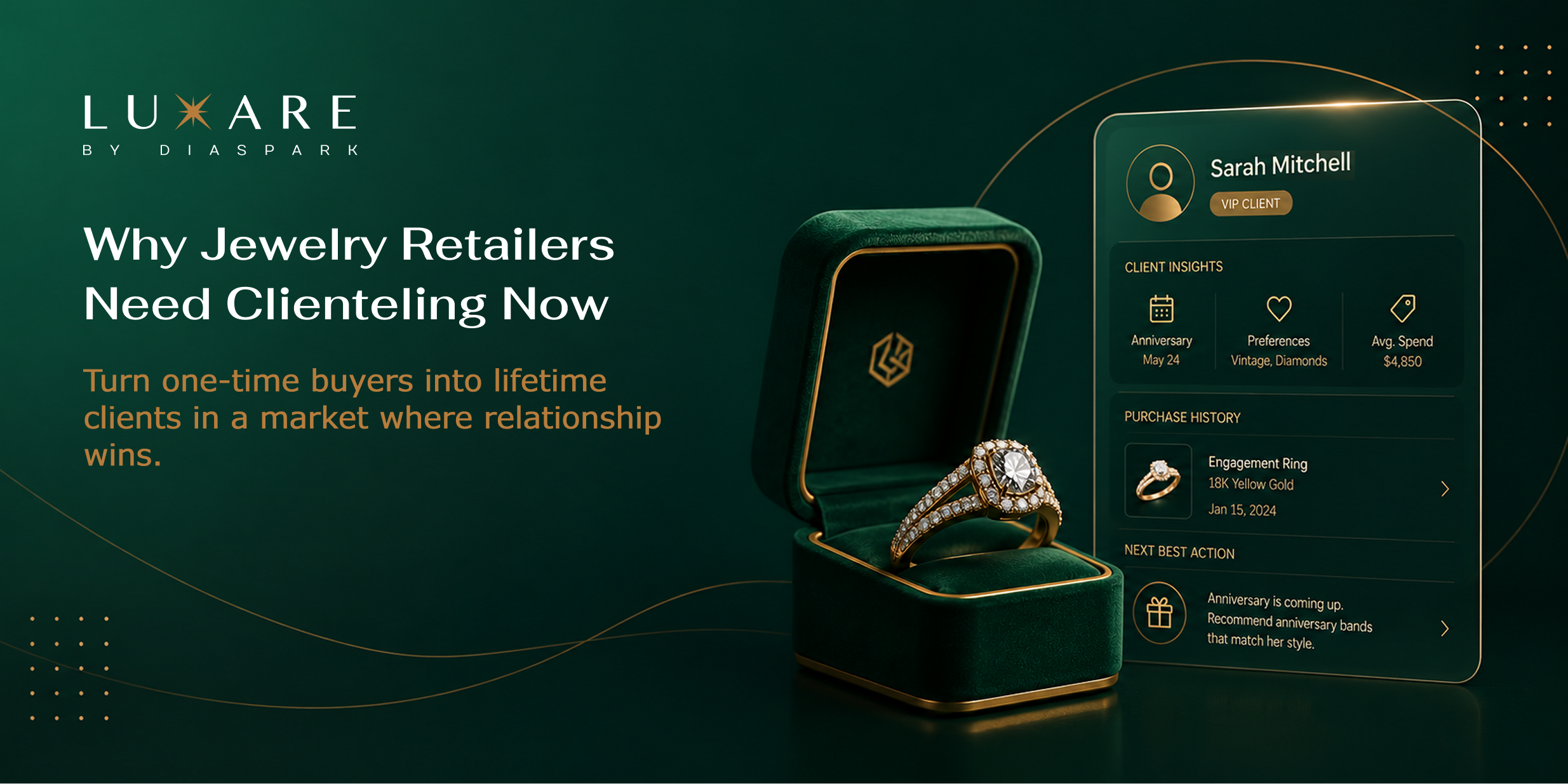
Only 9.9% of first-time jewelry buyers make a second purchase within a year. Meanwhile, online jewelry sales will make up 32.7% of total revenue in 2025, up from just 20.5% in 2018. Gold prices remain high. Foot traffic is down in a lot of markets. For jewelers the future is not about competing on inventory or price. It is competing on relationships. That’s what clienteling software is for at scale.
The Retention Crisis in Jewelry Retail
Here is the problem most jewelry retailers are not talking about: only about 9.9% of first-time jewelry customers make a second purchase within a year. For a high-value, low-frequency category like jewelry, that is devastating. It means that nearly 90% of the customers who walk in and buy something never come back.
This is not a problem that inventory breadth fixes. It is not a problem that lower prices fix. It is a problem of relationship. A customer who feels known comes back. A customer who was processed as a transaction and forgotten does not.
The cost impact is immediate. Acquiring a new customer costs 5-25 times more than retaining an existing one (Bain & Company). If you are spending acquisition budget to replace lost customers instead of deepening relationships with the ones you have, you are burning money. And you are doing it at scale.
The Competitive Pressure from E-Commerce
Online jewelry sales are projected to reach 32.7% of total revenue in 2025, up from just 20.5% in 2018 (Forgecraft, 2025). That number keeps climbing. By 2028, online is expected to represent 37.1% of total jewelry revenue.
For independent retailers and smaller chains, this is an existential pressure. You cannot compete on convenience or selection like Amazon or a direct-to-consumer brand can. You have no inventory advantage. You have no price advantage. The only thing you have that e-commerce does not is the ability to build a face-to-face relationship.
But only if you actually do it. Only if you have a system that surfaces those relationships and turns them into action. Clienteling is that system.

The Margin Reality: You Cannot Compete on Price
Gold prices are elevated. Your costs are up. But your ability to raise retail prices is limited by competition and consumer price sensitivity. Retailers are responding by tightening margins: gross margins in the jewelry industry are currently at 72%, which is where they need to be, but protecting those margins while costs stay elevated leaves very little room for error.
You cannot cut your way to profitability. You have to grow it. And the only path to growth in this environment is through customer lifetime value, not acquisition volume.
A repeat customer spends more per order than a first-time buyer. Brands that invest in retention marketing see repeat customers spend 32% more per order than new buyers (Jewelers Industry Benchmarks, 2026). That is not a small difference. That is the margin buffer that keeps you in business when gold prices spike and consumer spending softens.
What Repeat Customers Actually Generate
Let me reframe what a repeat customer is worth.
A one-time customer buys once. You acquire them at cost, they buy, you move on. If the cost of acquisition is high and the lifetime value is a single transaction, you are playing a numbers game you cannot win.
A repeat customer changes the equation. They buy again. They spend more per transaction. They refer friends. They tell people about you. They come back for repairs and maintenance and anniversaries. That client who bought an engagement ring five years ago? They come back for the anniversary band. Then the push gift. Then the birthday gift for their spouse. Over a lifetime, that single customer might spend 10-15 times the initial purchase amount with you.
And the cost to keep them? Significantly less than acquiring new customers. A single thoughtful text reminder. An anniversary call. A note when something matches their style arrives. Those are not expensive touchpoints. But they are the ones that keep clients coming back.
A 5% increase in customer retention can boost profits by 25-95% (Harvard Business Review). That range is wide, but even the conservative end is more than most other marketing investments deliver.

Why Now: The Market Window Is Closing
The retailers who are holding market share are the ones who have already moved to systematic clienteling. They have the tools. They have the data. They have habits. And they are pulling ahead.
For the rest of the market, the window to catch up is narrowing. E-commerce adoption is accelerating. Foot traffic is unpredictable. Consumer spending has shifted toward higher-value purchases (average per-item spending in jewelry is up 14% in 2025 compared to 2024), which means fewer transactions but higher stakes for each one.
In this environment, you need every customer to count. You need to convert more of those one-time buyers into repeat customers. You need to maximize the revenue from each relationship. You need to do it before your competitors do.
Clienteling software is not a nice-to-have anymore. For independent and mid-size jewelry retailers, it is the difference between holding your position and losing it.
Luxare AI Clienteling App
Built for luxury jewelry and watch retailers, launched at JCK Las Vegas 2026. Unified client profiles capturing every purchase, visit, and non-purchase interaction. An AI Sales Assistant that surfaces daily outreach opportunities. Text-first two-way SMS messaging. Smart waitlist and allocation intelligence. Appointment and event management. Mobile-first on iOS and Android. Native integration with Microsoft Business Central and a roadmap to unified CRM and POS.
Integrates seamlessly with your existing POS. You do not have to choose between clienteling and the systems you already trust.
Trusted by Signet Jewelers, Helzberg, Roberto Coin, and Hing Wa Lee Jewelers.
Visit the Product | Book a Demo
“The Luxare team feels like an extension of ours. They created a training manual and video that got our team up and running in no time. The setup was simple and quick. They understand who we are and what we are trying to accomplish, which has made it easy to overcome the challenges we have faced.”
Brian Wulff, DVP Customer Experience, Helzberg Jewelers
Frequently Asked Questions
We already have a POS. Isn’t that enough?
A POS handles transactions and inventory. Clienteling handles relationships. A POS stores the fact that a customer bought something. Clienteling surfaces when to reach out to that customer and what to say. Most POS systems have basic CRM fields but lack the active workflow tools, mobile interface, AI recommendations, and messaging that drive repeat business. Many retailers run their POS CRM for years without the proactive follow-up that transforms customers into clients.
Do we really need clienteling if we already know our regular clients well?
Personal relationships are valuable, but they do not scale. The moment an associate leaves, the relationships walk out the door. If you want that level of attention available to every customer from every associate every shift, you need a system. Clienteling is how you make your best associate’s habits available to the whole team.
Our foot traffic has been steady. Is clienteling urgent?
Foot traffic stability can mask a retention problem. You might think traffic is steady when what is actually happening is you are replacing lost customers with new ones at increasing acquisition cost. Clienteling is not about driving more foot traffic. It is about turning the traffic you get into repeat customers and higher lifetime value. In a market where acquisition costs are rising, that is urgent.
What if our customers do not want to be contacted?
When outreach is personalized and timely, most customers want it. Text messaging accounts for 39% of clienteling communications, up from 26% in 2022. Clients prefer contact that feels relevant to their life, not mass email blasts. Clienteling software ensures that every outreach is one-to-one and tied to something the customer actually cares about: an anniversary, a life event, a piece they showed interest in.
What is the ROI of clienteling software?
Direct ROI is measurable. A 5% increase in retention boosts profits by 25-95% (Bain & Company). Repeat customers spend 32% more per order than new buyers (Jewelry Industry Benchmarks). Acquiring a new customer costs 5-25 times more than retaining an existing one. For most retailers, the ROI on clienteling shows up in the first 90 days through higher conversion rates on follow-up and increased customer lifetime value.
Is clienteling software only for luxury stores?
No. Clienteling applies to any jewelry retail business: luxury boutiques, independent multi-location chains, watch dealers, even repair shops. The principle is the same: repeat customers spend more and cost less to serve. If that math works for your business, clienteling works for your business.
What if we do not have time to implement this?
You do not have time not to. The cost of maintaining the status quo is the cost of losing customers and being replaced by retailers who have already implemented systematic clienteling. Implementation typically takes days or weeks, not months. The time cost is front-loaded and then you have a system that drives revenue continuously.

Key Takeaways
- Only 9.9% of first-time jewelry customers make a second purchase within a year. That is not normal. That is a crisis.
- Online jewelry sales are growing from 20.5% of revenue in 2018 to 32.7% in 2025. You cannot compete on convenience with e-commerce.
- Margins are compressed. Gold prices are elevated. You cannot compete on price.
- Your only competitive advantage is relationships. Clienteling is how you build them at scale.
- Repeat customers spend 32% more per order than first-time buyers.
- A 5% increase in retention can boost profits by 25-95%.
- The retailers who have already moved to clienteling are pulling ahead. The window to catch up is closing.
- The retailers doing this are already your competitors. This is not optional anymore.
Retention Is Now Your Competitive Advantage
Your store is not failing because your inventory is wrong or your prices are too high. It is failing because 90% of the customers who walk in and buy something never come back. And every quarter, you spend more money acquiring replacements instead of deepening the relationships you already have.
Clienteling software fixes that. It does not fix foot traffic or gold prices or the rise of e-commerce. But it fixes the one thing you can actually control: turning one-time customers into repeat customers.
The retailers who figure this out first will own their markets. The ones who wait will watch their margins shrink and their market share erode to competitors who understood it earlier.
The Only Question Is When, Not If
Trusted by 70+ Leading Jewelers
See how Luxare’s AI Clienteling App works for your retail team in one demo.
Related Resources
Clienteling vs CRM for Jewelry Stores: What Is the Difference?
Think your POS CRM is enough? Discover why basic record-keeping might be costing your jewelry store sales, and how active clienteling turns passive data into proactive, revenue-driving relationships.
Clienteling vs CRM for Jewelry Stores: What Is the Difference?
Think your POS CRM is enough? Discover why basic record-keeping might be costing your jewelry store sales, and how active clienteling turns passive data into proactive, revenue-driving relationships.
Clienteling vs CRM for Jewelry Stores: What Is the Difference?
Think your POS CRM is enough? Discover why basic record-keeping might be costing your jewelry store sales, and how active clienteling turns passive data into proactive, revenue-driving relationships.
What Is Clienteling in Retail? A Guide for Jewelry and Watch Store Owners
Clienteling builds long-term, personalized client relationships by tracking preferences, purchase history, and life events. In jewelry retail, this strategy drives lifetime value by moving beyond one-time transactions to occasion-driven outreach.
What Is Clienteling in Retail? A Guide for Jewelry and Watch Store Owners
Clienteling builds long-term, personalized client relationships by tracking preferences, purchase history, and life events. In jewelry retail, this strategy drives lifetime value by moving beyond one-time transactions to occasion-driven outreach.
What Is Clienteling in Retail? A Guide for Jewelry and Watch Store Owners
Clienteling builds long-term, personalized client relationships by tracking preferences, purchase history, and life events. In jewelry retail, this strategy drives lifetime value by moving beyond one-time transactions to occasion-driven outreach.
Clienteling app for Jewelry Stores: What It Does and Why It Matters
The clienteling app for jewelry stores is a mobile-first solution that centralizes client profiles, offers AI-driven outreach, and manages waitlists for high-value retail. It integrates purchase history and preferences into a single profile, guiding associates on who to contact and what to recommend.
Clienteling app for Jewelry Stores: What It Does and Why It Matters
The clienteling app for jewelry stores is a mobile-first solution that centralizes client profiles, offers AI-driven outreach, and manages waitlists for high-value retail. It integrates purchase history and preferences into a single profile, guiding associates on who to contact and what to recommend.
Clienteling app for Jewelry Stores: What It Does and Why It Matters
The clienteling app for jewelry stores is a mobile-first solution that centralizes client profiles, offers AI-driven outreach, and manages waitlists for high-value retail. It integrates purchase history and preferences into a single profile, guiding associates on who to contact and what to recommend.


